
How to create an IT budget for a small business: 5 categories
TL;DR: To create a small business IT budget, categorize expenses into hardware, cloud, and operations while allocating contingency for technical debt.
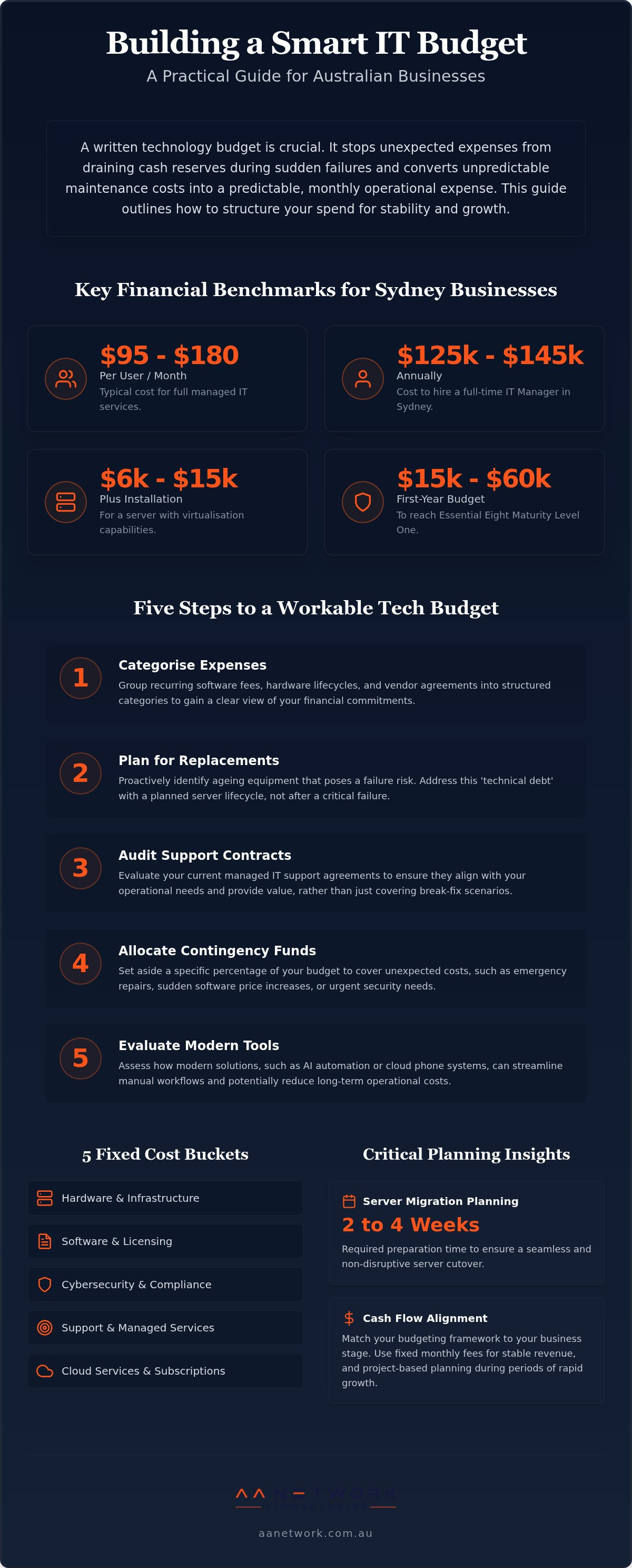
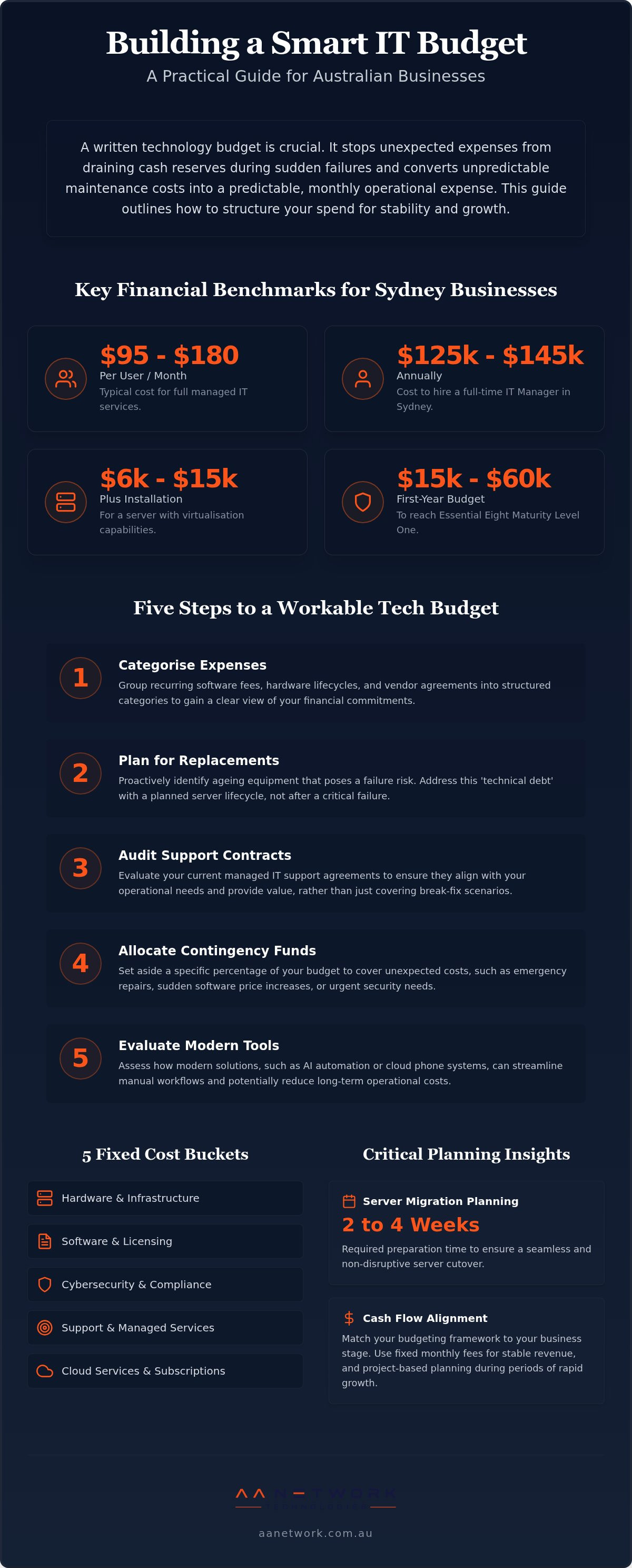
- Market pricing for basic IT tools ranges from $100 to $4,500 based on industry benchmarks.
- Static budgets fail unless you use dynamic forecasting to adapt during rapid Sydney-based growth.
- Group costs into two fixed buckets to convert unpredictable maintenance into predictable monthly operational items.
- Server migration planning requires two to four weeks of preparation to ensure a seamless cutover.
Building a balanced technology budget means structuring spend across five core operational categories and aligning cash flow with realistic market benchmarks. In Sydney CBD, Parramatta and Greater Sydney, paying for ongoing IT support (managed IT services) gives you a reliable baseline for predictable technology forecasting. The decision questions that run through this guide are simple: which costs stay fixed, which flex with growth, and how much contingency you set aside so old hardware and sudden outages do not drain cash.
Match cash flow to tech plans before you commit funds
Choosing how to start a budget (budgeting framework) means aligning tech plans with cash flow so growth goals do not collide with monthly bills.
Three situations we see often, with concrete moves drawn from the same facts you will use below:
- Stable headcount and steady revenue: lock recurring tools under fixed monthly fees and keep project spend separate.
- Growth hiring across Sydney sites: favour project-based planning for upgrades, and schedule server work with the two-to-four-week planning window before cutover.
- Aging kit and surprise repair bills: set a contingency percentage early and retire technical debt on a defined server lifecycle, not after failure.
Mixing predictable costs with growth goals creates financial stability. Small teams need clear boundaries to avoid overspending on technology. Grouping your expenditures (cost categories) splits recurring subscriptions from standalone projects and keeps monthly spend predictable for Sydney firms.
Before committing funds, review How Much Should a Small Business Spend on IT in Australia? to benchmark your figures.
Managing unexpected expenses (contingency percentage) prevents cash flow shocks; old hardware costs (technical debt) often trigger those surprise bills. If you need quick on-site support, talk with our founder and schedule a complimentary IT Health Check to evaluate your current setup.
A written IT budget stops cash drains from sudden failures
A clear technology plan stops unexpected expenses from draining company cash reserves during sudden network failures.
As noted by the ABLIS 2026 business guidelines, running a commercial venture requires precise operational planning to maintain regulatory compliance. Operating without a financial safety net is like driving in Sydney CBD without brakes. AA Network Technologies is an Australian IT consulting, managed services and cybersecurity company focused on helping businesses use technology with greater confidence, security and control.
Failing to budget for replacing old servers (server lifecycle management) creates dangerous bottlenecks, so account for old hardware costs early. Ignoring Cyber Security Sydney | Small Business Cyber Security exposes your local enterprise to catastrophic data breaches. Planned spending keeps the team operational and protects cash when incidents hit.
Five fixed cost buckets keep monthly spend predictable
Categorize expenses systematically to establish an accurate budgeting framework (how to start a budget).
Monitoring software renewals together with phone system upgrades stops unexpected budget redundancies. For clear communication setups, review the Sydney Small Business Cloud Phone Systems: 2026 Guide to align modern tools with your general spending targets. A planned cloud migration (moving to the cloud) helps organize Operations; guard against lost emails or staff downtime during the transition.
| Expense Category | Business Focus |
|---|---|
| Hardware & Cloud | Laptops, local infrastructure, cloud migration |
| Operations | Software licenses, managed IT services |
Typical IT expenses span a broad market price band with a modest median, based on current industry cost benchmarks. Fixed allocations suit stable cost lines.
Tip: Group hardware, software, security, support, and cloud into five fixed buckets to avoid surprise cost spikes.
Five steps that turn hardware lifespans into a workable tech budget
Establishing a practical IT plan requires systematic cost tracking. In client projects, mapping actual hardware lifespans comes first: unplanned upgrades break annual spending plans quickly. A typical small business server migration takes two to four weeks of planning and preparation.
Follow this process to prepare your plan:
- Categorize expenses: Group your recurring software fees, hardware costs, and vendor agreements into structured groups.
- Review replacing old servers: Identify aging equipment that risks failing and requires full replacement soon.
- Audit ongoing IT support: Evaluate current support contracts to ensure your maintenance needs fit team Operations.
- Calculate unexpected expenses: Set aside extra funds specifically to cover emergency repairs or sudden software price rises.
- Evaluate modern tools: Check how modern options like the Top AI Automation Tools for Australian Small Business can streamline manual workflows.
A solid budgeting framework gives you clarity on where money goes. Managing technical debt (old hardware costs) early stops sudden failures. If you are choosing between cloud migration and local upgrades, plan the transition in careful steps so mail and staff access stay intact.
Fixed targets and live forecasts work together, not as substitutes
A budget sets fixed spending targets for your Operations, while a financial forecast predicts future cash flow based on changing market conditions.
Think of your budget as a fixed architectural blueprint and your forecast as a live GPS navigation system. Budgeting establishes baseline spending limits; dynamic forecasting lets you adapt when launching new products or expanding across Sydney CBD and Parramatta.
Data from the Prospa (company) 2026 Wikipedia page highlights how financial services track changing market demands to guide business decisions.
Categorize expenses before you update growth projections. Fixed targets keep daily Operations grounded; moving targets help you capture new business opportunities without running out of cash. Reserve a no-cost IT Health Check through AA Network Technologies to match tech investments with actual company expansion.
Pick tools that track live cash when revenue swings
Choosing software that syncs with your bank accounts gives you real-time visibility over cash flow during peak periods. Manual spreadsheets fail growing businesses because they miss live transaction data; automated tracking prevents costly data errors when revenues swing throughout the year.
Linking your accounting tool straight to your payment processors reveals unexpected fee surges during peak seasons. When you learn how to start a budget, pick flexible platforms over rigid tools. Dynamic forecasting suits variable income models, while basic fixed ledgers fit predictable Operations. Modern systems streamline categorizing expenses tasks automatically.
If your team struggles to track cash trends across Sydney CBD, AA Network Technologies helps simplify your stack: book a free IT Health Check to tighten operational tools.
Flexible IT spend beats locked allocations when you scale
Rigid financial plans break when your business needs to scale or fix sudden system outages. Fixed budgets lock you into outdated tech.
Small firms often burn money fixing old hardware costs instead of upgrading; delaying infrastructure replacements leads to higher long-term expenditure. A static model acts like a locked steering wheel: you cannot swerve around immediate operational bottlenecks.
If your Sydney CBD office expands rapidly, locked funds prevent fast hiring. Flexible spending fits growth companies, while fixed allocations only suit static Operations.
Switching to ongoing IT support converts unpredictable maintenance fees into predictable operational items. For major transitions, moving to the cloud (cloud migration) offers agility when you plan the cutover path in advance. Ready to modernise your tech spend? Book a free IT Health Check with AA Network Technologies today.
Build contingency for physical security and NSW compliance
Build unexpected expenses into your plan to handle physical safety needs alongside software updates.
Hardware installations often trigger unexpected physical adjustments. Planning for extra cabling or mounting hardware upfront protects your operational bottom line.
Physical monitoring requires strict adherence to local laws. In NSW, installing security equipment such as CCTV is regulated work under the Security Industry Act 1997 and must be done by the holder of an appropriate Class 2 security licence. Working with certified experts keeps you fully compliant.
Hardware choices vary greatly: basic systems fit small offices, while custom setups suit multi-site Operations. Book a free IT Health Check when you want the security line items sized against your sites.
Quarterly variance checks keep tech spend on target
Compare your actual operational expenses against your plan every quarter to keep spending on track.
Small businesses often forget to track hidden operational shifts. Tracking variance helps you adjust before minor overruns become serious financial problems.
Compare your ledger entries to your original target lines. Did ongoing IT support stay within its limit? Were there any unexpected expenses that ate into your cash flow? Line-by-line review shows where the plan still holds.
Regular reviews ensure your tech spend fuels real business growth across Greater Sydney. Contact our founder to refine your process.
Frequently asked questions
Why does a small business need a budget?
A clear plan prevents unexpected expenses from draining your working capital during routine tech updates. It helps you control operational spending while prioritizing essential upgrades for your team. You gain predictability over monthly bills and can schedule major projects without disrupting cash flow.
How should I categorize expenses?
Separate fixed operational recurring fees from one-off infrastructure investments. Divide items into software tools, hardware maintenance, cloud services, and ongoing IT support. Grouping expenses this way keeps your ledger clean and simplifies financial reporting.
How does a budget differ from a forecast?
A budget outlines your intended spending targets, whereas a forecast estimates future financial outcomes using real data. Setting up your plan shows how to start a budget based on concrete business goals. A forecast adjusts those projections as revenue or market conditions shift.
Is your budget hitting the mark?
You will know your plan works when routine operational demands no longer cause sudden financial stress. Dealing with old hardware costs becomes predictable instead of an emergency expense. Tracking performance monthly ensures that your spending aligns directly with your broader business targets.
Can a business budget help with loan or credit applications?
Lenders view structured technology planning as proof of disciplined operational management. Showing clear plans for replacing old servers reassures financial institutions that you manage long-term risks effectively. Documented expenditure projections strengthen your overall application profile.
Take Control of Your Technology Spending
Learning how to start a budget prevents sudden cost overruns in 2026.
Many managers struggle with unexpected expenses when plans change; setting clear funds aside keeps Operations stable. As a local Australian company meeting strict NSW security licence requirements, AA Network Technologies provides strategic IT consulting across Sydney CBD, Parramatta, and North Sydney.
We help you manage old hardware costs and set up reliable ongoing IT support. Aligning technology with business growth leads to predictable financial results. Book a free 30-minute IT Health Check today to discuss your setup with our team.