
How Much Should a Small Business Spend on IT in Australia? 2026 Budget Guide
If your monthly IT invoice is the only way you track technology costs, you're likely missing the hidden expenses of downtime and subscription creep. With the small business exemption in the Privacy Act set to vanish on 10 December 2026, the question of how much should a small business spend on IT in Australia has shifted from a matter of choice to one of mandatory compliance. Under-investing now doesn't just lead to slow computers; it creates significant financial risk for your firm.
It's frustrating to feel like you're pouring capital into a black hole of software subscriptions and "break-fix" repairs without seeing a clear return. You need a predictable budget that protects your reputation and meets Australian security standards without wasting money on unnecessary tools. Most business owners just want technology that works reliably so their team can stay productive and focused on their clients.
This 2026 budget guide provides a practical breakdown of technology benchmarks and cost drivers specifically for Australian SMEs from Sydney CBD to Canberra. We'll show you how to calculate a budget that aligns with the Essential Eight framework and manages your risk effectively. You'll learn how to turn unpredictable capital expenditure into a steady, manageable operating cost that actually supports your long-term business goals.
Key Takeaways
- Determine how much should a small business spend on IT in Australia by using industry-standard revenue benchmarks between 2 per cent and 7 per cent.
- Identify the primary cost drivers like headcount and licensing to ensure your technology budget remains predictable and scalable.
- Optimise your spending by limiting maintenance costs to 70 per cent of your budget; this leaves room for projects that improve staff efficiency.
- Align your investment with the Essential Eight framework to meet Australian security standards and protect your reputation from data breaches.
- Evaluate the cost-effectiveness of outsourced managed IT support versus internal hires to achieve better reliability and higher-level expertise.
Australian IT Spending Benchmarks: The 2 Per Cent to 7 Per Cent Rule
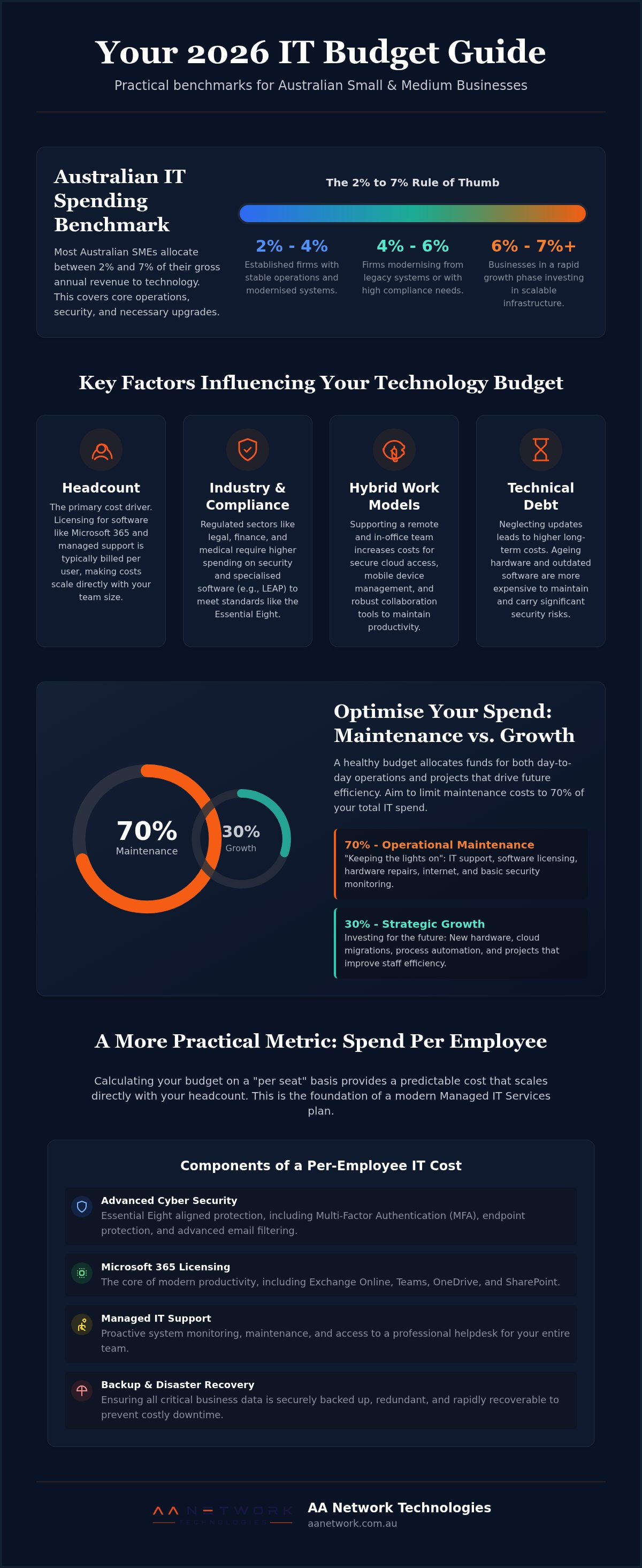
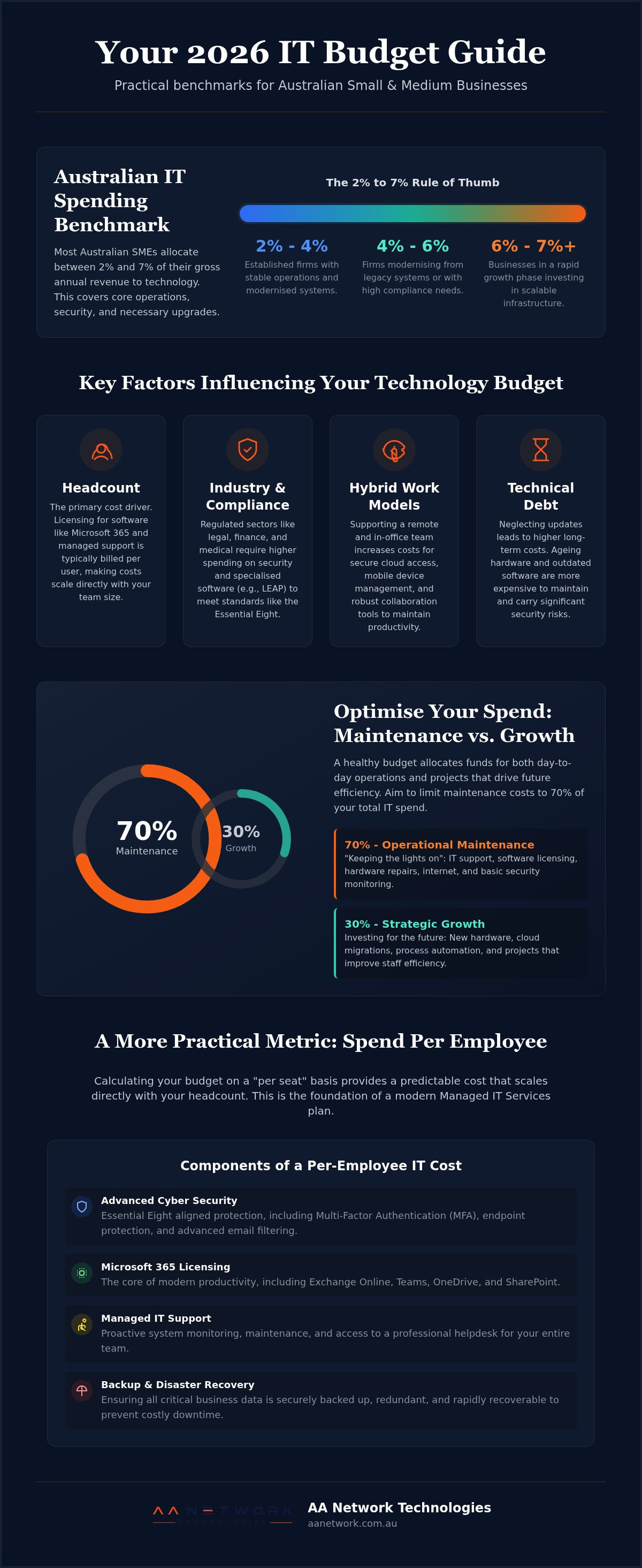
A standard IT budget covers everything required to keep your operations running, secure, and compliant. When determining how much should a small business spend on IT in Australia, most firms in Sydney CBD or Parramatta find themselves allocating between 2 per cent and 7 per cent of their gross annual revenue. This range allows for core maintenance while providing a buffer for necessary security upgrades and hardware refreshes.
Businesses in a rapid growth phase often lean toward the 7 per cent mark. They need to invest heavily in scalable cloud infrastructure and new hardware to support a growing headcount. Conversely, established firms with stable operations might aim for the 4 per cent range. However, those clinging to legacy systems often struggle to stay below this threshold due to the rising costs of maintaining ageing hardware and the increased risk of system failure.
Why the Percentage Range is So Broad
The variety of business models in Australia means a one-size-fits-all percentage rarely works. A 5-person consultancy has vastly different requirements than a 50-person law firm or medical practice. Industry-specific software requirements, such as LEAP for legal professionals or specialised practice management systems for medical clinics, immediately inflate the baseline budget. These platforms often require specific server configurations or high-level integration support that a standard retail business would not need.
Technical debt also plays a significant role in these variations. If a business has neglected updates for several years, their annual spend will spike when they are forced to modernise. Applying IT cost transparency principles helps owners see exactly where their money goes, separating basic "keep the lights on" costs from strategic investments. This clarity prevents the frustration of unpredictable monthly invoices that don't seem to correlate with business value.
IT Spend Per Employee: A More Accurate Metric?
Many managers find that "spend per seat" is a more practical way to calculate how much should a small business spend on IT in Australia. This metric ties your technology costs directly to your headcount, making it easier to predict expenses as you hire new staff. This approach is particularly useful for businesses in Macquarie Park or Norwest that rely on a hybrid workforce. It allows you to scale your IT costs up or down instantly, preventing the subscription creep where you pay for unused software.
The foundation of this per-employee cost is usually your Microsoft 365 licensing. Beyond the basic license, you must account for several critical components:
- Managed IT support: Access to a helpdesk and proactive system monitoring.
- Advanced cyber security: Implementing MFA, endpoint protection, and email filtering.
- Backup and disaster recovery: Ensuring data is redundant and recoverable.
- Network management: Maintaining high-speed internet and secure Wi-Fi.
A basic support model will sit at the lower end of the price scale. However, businesses in regulated sectors like finance or healthcare should budget for high-security managed services that align with the Essential Eight. This ensures you meet Australian Privacy Principles while maintaining high staff productivity.
Key Factors Influencing Your Technology Budget in 2026
When calculating how much should a small business spend on IT in Australia, your specific business profile determines where you sit on the spending spectrum. Headcount is the primary variable. Most software licensing, including Microsoft 365, is billed per user. Similarly, managed IT support is typically priced per seat. If you're a growing firm in Parramatta, adding five new staff members doesn't just increase your payroll; it creates an immediate, predictable step-up in your technology overheads.
The shift to hybrid work has also rewritten the rules for Sydney CBD firms. Supporting a team that splits time between the office and home requires more than just laptops. You must budget for secure remote access, mobile device management, and robust cloud-based collaboration tools. For professional services like legal or accounting, high-uptime requirements are non-negotiable. A single hour of downtime for a 20-person firm can cost thousands in lost billable hours. Investing in redundancy and proactive monitoring is a commercial necessity rather than a luxury.
Industry Compliance and Regulatory Pressure
Regulatory demands are a major budget driver for Australian medical, legal, and accounting practices. From 10 December 2026, the removal of the small business exemption in the Privacy Act means most SMEs must comply with the Australian Privacy Principles. This necessitates a higher security spend on data encryption and access controls. Meeting these standards requires more than just software; it involves regular security training for your staff and documented incident response plans. Aligning with the Essential Eight framework provides a roadmap for this compliance, helping you avoid the reputational damage of a data breach.
Infrastructure Maturity: Cloud vs On-Premise
Planning how much should a small business spend on IT in Australia requires a clear look at your infrastructure maturity. Your choice between maintaining a local server room or moving to the cloud changes your financial structure. A cloud migration Sydney project can shift your IT spend from large, unpredictable capital outlays to a steady monthly operating expense.
While local servers seem cheaper upfront, they carry hidden costs like specialised cooling, high electricity bills, and emergency hardware repairs as they age. Azure and other cloud platforms provide built-in disaster recovery and scalability that local hardware simply cannot match. If you are unsure which model fits your 2026 goals, you can speak with a local consultant to see a cost comparison for your specific site.
Breaking Down the Spend: Operational Maintenance vs Strategic Growth
Calculating how much should a small business spend on IT in Australia requires a clear distinction between keeping the lights on and driving the business forward. We use the "Run, Grow, Transform" model to categorise technology expenses. Ideally, your "Run" costs should consume less than 70 per cent of your total technology budget. If maintenance is eating up more than that, you're likely overpaying for inefficient legacy systems or redundant services.
A disciplined hardware refresh cycle is another critical component of this split. Many Sydney firms try to stretch the life of a laptop to five or six years, but the resulting productivity dips and repair costs often exceed the price of a new device. We recommend a three to four year refresh cycle for primary workstations. This ensures your staff have the processing power needed for modern security software and collaboration tools without the frustration of constant system lag.
Operational Costs (The "Run" Budget)
The "Run" budget covers your non-negotiable essentials. This includes your managed IT support Sydney fees, high-speed internet, and basic software licensing. Skimping on these core services is a false economy. Poorly supported systems lead to expensive downtime that halts your billable work and frustrates your clients. Reliable support acts as a proactive guard, catching minor glitches before they become major operational hurdles.
Many Australian SMBs waste significant capital on "SaaS creep" where subscription costs spiral out of control. It's common to find firms paying for multiple tools that perform the same function. Use this checklist to identify waste in your current billing:
- Redundant Storage: Are you paying for Dropbox or Box when you already have 1TB of storage per user in OneDrive?
- Overlapping Communication: Do you pay for Slack or Zoom subscriptions while your team already has access to Microsoft Teams?
- Zombie Licenses: Are you still paying monthly fees for staff members who left the business months ago?
- Shadow IT: Have individual departments signed up for specialised tools without centralising the billing or security oversight?
Strategic Investment (The "Grow" Budget)
Once your operational costs are lean, you can pivot toward strategic growth. This is where you invest in technology that improves your bottom line. For professional services, the ROI of AI automation Sydney is becoming clear in 2026. Automating repetitive data entry or document drafting allows your senior staff to focus on high-value advisory work rather than administrative tasks.
Microsoft 365 optimisation is often the most cost-effective way to "Grow" your business capabilities. Most firms only use a fraction of their subscription's potential. By properly configuring SharePoint and Power Automate, you can often replace three or four separate paid tools. Regular IT consulting ensures your technology roadmap stays aligned with your commercial goals, turning your IT spend into a measurable business advantage.
Budgeting for Cyber Security and the Essential Eight
Cyber security is no longer an optional line item in your profit and loss statement. For any professional practice, it's the foundation of your operational stability. The Australian Signals Directorate (ASD) recommends the Essential Eight framework as the baseline for all Australian businesses. When you're deciding how much should a small business spend on IT in Australia, security must be prioritised to prevent catastrophic data loss and financial ruin.
Under-funding your security creates a massive commercial risk. A data breach at a Sydney accounting or law firm doesn't just result in a fine; it destroys client trust that took decades to build. Cyber insurance providers have also become far more selective. They often refuse coverage or hike premiums if you haven't implemented basic controls like multi-factor authentication (MFA). Determining how much should a small business spend on IT in Australia involves weighing the cost of these protections against the price of a total system failure.
The Cost of Essential Eight Compliance
Implementing the Essential Eight requires a mix of software and process changes. You need to budget for robust endpoint protection, automated patching, and restricted administrative privileges. These aren't just "IT tasks"; they are risk management strategies. For example, cyber security for law firms Sydney involves strict access controls to protect sensitive privileged communications and meet the latest compliance standards.
Don't overlook the human element. Security awareness training for your staff is a low-cost, high-impact investment. Most breaches start with a simple phishing email. Teaching your team in Parramatta or Western Sydney how to spot a suspicious link is one of the most effective ways to stretch your security budget. It's a proactive step that builds a "human firewall" around your most sensitive data.
Backup and Disaster Recovery: Insurance for Your Data
A true backup strategy is more than just syncing files to a cloud drive. You must include backup retention and regular restore testing as specific line items in your budget. If you can't restore your data within a few hours, your business is at a standstill. This is where your Recovery Time Objective (RTO) matters. A lower RTO means you get back to work faster, but it typically requires a more sophisticated solution.
Simple cloud storage might take days to download and restore your entire system. A dedicated disaster recovery solution allows you to spin up your servers in the cloud almost instantly. You're paying for the peace of mind that your business can survive a server failure or a ransomware attack without losing weeks of work. It's an essential safeguard for any firm that cannot afford a day of lost productivity.
Managed IT Services: Predictable Costs for Sydney SMEs
Hiring a full-time IT manager in Australia is a significant financial commitment. Beyond a base salary that often exceeds $100,000 for experienced practitioners, you must account for superannuation, payroll tax, and ongoing training. For most firms with 5 to 100 users, an outsourced managed service provider (MSP) offers a far more sensible answer to the question of how much should a small business spend on IT in Australia. You gain access to a whole team of specialists for a fraction of the cost of a single senior hire.
The "all-you-can-eat" managed support model is designed specifically for budget predictability. Instead of worrying about fluctuating hourly rates every time a staff member has a technical glitch, you pay a flat monthly fee. This turns your technology spend into a fixed operating expense, making it much easier to manage your cash flow. Because your interests align with your provider, they are incentivised to keep your systems running perfectly rather than waiting for things to break so they can bill more hours.
Local, on-site support remains a critical factor for businesses in Parramatta, North Sydney, or Macquarie Park. While many tasks can be handled remotely, some hardware failures or network issues require a physical presence. A senior-led MSP provides practitioner-level expertise without the executive price tag associated with larger, more rigid corporate IT firms. This high-touch approach ensures that your technology partner actually understands your specific office environment and the daily pressures your staff face.
The ROI of Proactive Monitoring
The true value of managed IT lies in what doesn't happen. Proactive monitoring catches failing hard drives, security vulnerabilities, and backup errors before they cause a crisis. If your Sydney CBD firm avoids just two hours of total downtime a month, the recovered billable time often pays for the entire managed service. This proactive stance includes lifecycle management, ensuring you aren't surprised by a fleet of laptops reaching end-of-life at the same time.
Professional services firms benefit from having a partner who maintains clear asset visibility. Knowing exactly what hardware you own and when it needs replacing allows for long-term financial planning. It removes the stress of emergency capital outlays and ensures your team always has the tools they need to stay productive. This level of oversight is a core part of determining how much should a small business spend on IT in Australia to remain competitive in 2026.
Next Steps: Booking an IT & Cyber Security Review
Moving from guesswork to a data-driven budget starts with a clear understanding of your current environment. We offer a 30-minute IT health check to help Sydney business owners identify hidden risks and cost-saving opportunities. This isn't a high-pressure sales meeting; it's a practical assessment of your infrastructure, security, and licensing.
During this session, we'll look for "SaaS creep" and hardware bottlenecks that might be dragging down your team's efficiency. You will walk away with a clear recommendation on how to align your technology spend with your commercial goals. Contact AA Network Technologies today to organise your assessment and get a predictable roadmap for your 2026 technology budget.
Securing Your 2026 Technology Roadmap
Balancing the 2 per cent to 7 per cent benchmark with proactive security is essential for any professional firm. By shifting focus from simple maintenance to strategic growth, you ensure your capital isn't wasted on redundant subscriptions or ageing hardware. Determining how much should a small business spend on IT in Australia is ultimately a decision about risk management and commercial efficiency.
We provide responsive on-site support across Sydney CBD and Parramatta to ensure your team stays productive without the frustration of technical delays. Moving toward a predictable, managed cost model protects your reputation while giving you the peace of mind to focus on your clients.
Taking control of your technology budget today turns your IT infrastructure into a reliable engine for your business success.
Frequently Asked Questions
How much does the average Australian small business spend on IT per month?
Most Australian small businesses spend between 2 per cent and 7 per cent of their gross annual revenue on technology. For a typical firm with 20 users, this investment covers managed support, software licensing, and security. The exact figure depends on your industry complexity and reliance on high-uptime systems. Using these revenue-based benchmarks helps you determine how much should a small business spend on IT in Australia to remain competitive in 2026.
Is it cheaper to hire an internal IT person or use a managed service provider?
Using a managed service provider is significantly more cost-effective for businesses with 5 to 100 users. An internal IT hire requires a full-time salary, superannuation, and payroll tax; often exceeding $100,000 annually. An MSP provides a whole team of specialists for a predictable monthly fee. This model gives you access to higher-level expertise and proactive monitoring that a single internal staff member cannot realistically provide alone.
What percentage of my revenue should go toward cyber security specifically?
Cyber security should ideally account for 10 per cent to 20 per cent of your total technology budget. As regulatory pressure increases with the Privacy Act changes in December 2026, many firms are shifting more capital toward data protection. This investment covers essential controls like MFA, endpoint protection, and staff training. It is better to view this as insurance for your data rather than a simple operational cost.
Does a Sydney-based business pay more for IT support than regional firms?
Sydney-based businesses often face higher costs for on-site support due to the increased overheads of operating in the CBD or Parramatta. However, the density of providers in Macquarie Park and North Sydney also creates a competitive market. While remote support costs are generally consistent across Australia, firms in metropolitan areas benefit from faster on-site response times for critical hardware failures or complex new office setups.
How can I reduce my IT spend without compromising on security?
Reducing your IT spend starts with eliminating "SaaS creep" and redundant software subscriptions. Many firms pay for separate tools that are already included in their Microsoft 365 licensing. Consolidating these services into a single platform reduces your monthly bill while simplifying your security management. Regular IT consulting helps you identify these efficiencies, ensuring you only pay for technology that actually improves your staff's productivity and protects your reputation.
What are the hidden costs of a "break-fix" IT model?
The hidden costs of a break-fix model include lost billable hours, reputational damage, and high emergency repair fees. When you only call for help after something breaks, you're paying for reactive fixes rather than prevention. This leads to unpredictable monthly invoices and extended downtime. A proactive managed model removes these frustrations by catching technical glitches before they stop your team from working and causing financial risk.
Should I budget for new hardware every year or every three years?
You should budget for a hardware refresh every three to four years for primary workstations. While stretching a laptop's life to five years seems like a saving, the resulting performance drops and increased support calls often cost more in lost productivity. Modern security software also requires newer processors to run efficiently without slowing down the user. A three-year cycle ensures your team remains efficient and secure.
How much does it cost to implement the Essential Eight for a small business?
The cost to implement the Essential Eight varies based on your current infrastructure maturity and target maturity level. Most small businesses find that aligning with the framework requires an initial project to configure MFA, patching, and backups correctly. Once established, the ongoing cost is usually absorbed into a comprehensive managed IT service. This investment is crucial for meeting Australian security standards and reducing your monthly cyber insurance premiums.
Sources and further reading
- Essential Eight, Australian Signals Directorate
- Notifiable Data Breaches scheme, OAIC
- Microsoft 365 security documentation, Microsoft Learn
- Backups, Australian Signals Directorate
Reviewed by AA Network Technologies, October 2026. This article provides general information, not legal advice.
Book an IT & Cyber Security Review or talk to our Managed IT team.