
Business Continuity Plan Checklist: Securing Your Sydney Firm in 2026
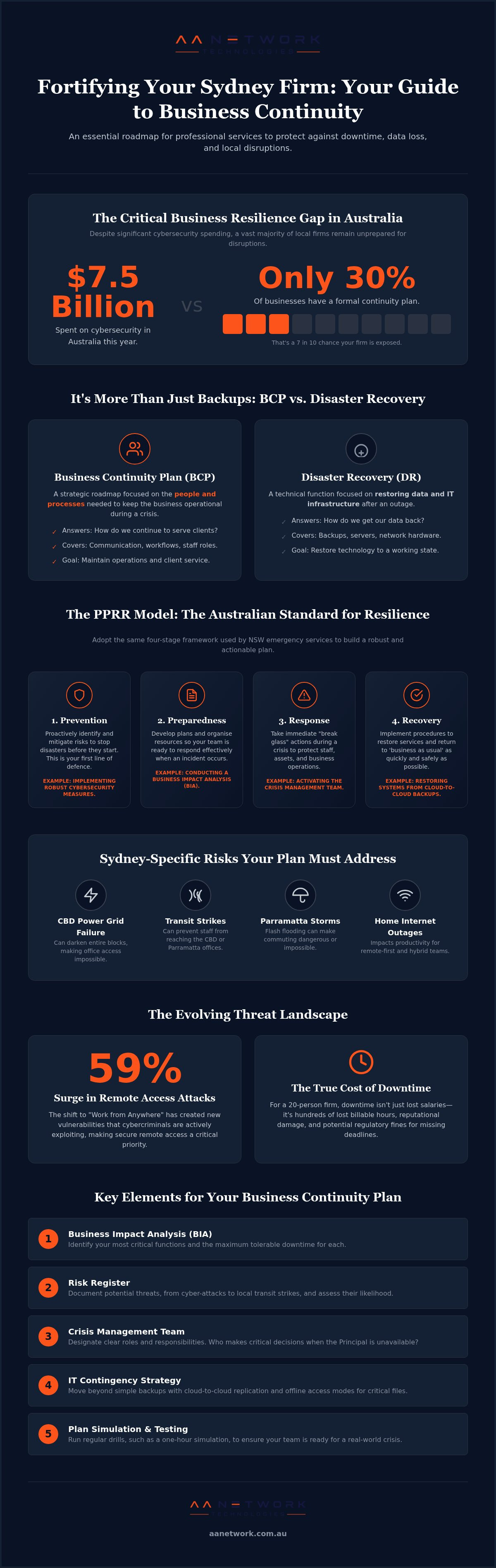
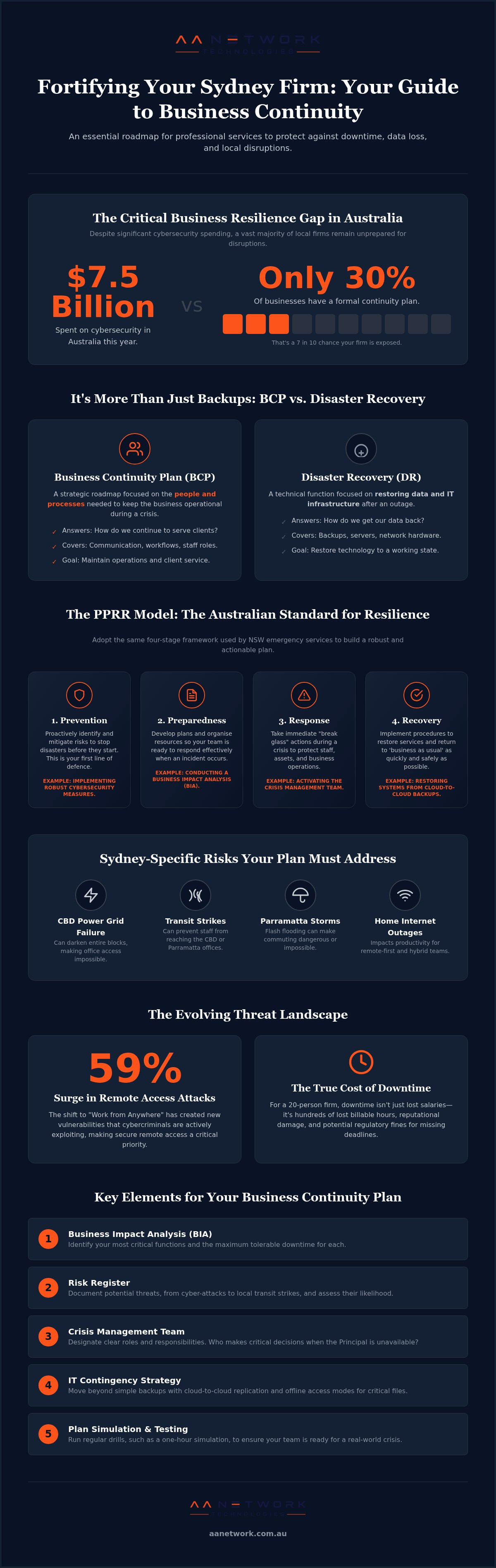
Did you know that despite Australian cybersecurity spending hitting $7.5 billion this year, only 30% of local businesses actually have a formal business continuity plan? For a professional service firm in the Sydney CBD or Parramatta, that is a massive gamble you shouldn't have to take. It is easy to feel the pressure when a sudden power outage hits George Street or a transit strike stops your team from reaching the office, leaving you worried about client deadlines and data security.
We understand that the difference between a simple backup and a true resilience strategy can feel confusing. You deserve the peace of mind that comes from knowing your staff can work from home seamlessly while staying compliant with the latest 2026 privacy regulations. This guide provides a clear, actionable roadmap to protect your firm from downtime and data loss. We will break down exactly how to secure your operations, from technical redundancies to local recovery steps, so you can stay focused on your clients while we watch your back.
Key Takeaways
- Understand why a business continuity plan is the essential 'Plan B' for protecting your Sydney firm from power outages and local disruptions.
- Learn how to apply the PPRR model, the Australian standard for resilience used by NSW emergency services, to your daily operations.
- Discover why relying on the cloud isn't enough and how to secure your data with cloud-to-cloud backups and offline access modes.
- Identify your firm’s most critical functions and build a risk register that covers everything from cyber-attacks to CBD transit strikes.
- Find out how to move beyond a paper plan by running a one-hour simulation to ensure your team is ready for a real-world crisis.
What is a Business Continuity Plan (BCP) and Why Does it Matter in 2026?
Think of a What is a Business Continuity Plan as your firm's ultimate "Plan B." It is the strategic roadmap that ensures your operations don't grind to a halt when the unexpected happens. While many business owners assume their daily backups have them covered, a backup is just a pile of data. A business continuity plan is about the people, the processes, and the specific steps required to keep serving your clients while the primary systems are down.
In 2026, the threats we face have evolved far beyond the traditional office fire. While physical disasters still happen, we are now dealing with a 59% surge in remote access attacks and frequent cloud outages that can lock a firm out of its own files for days. If you are running a law, finance, or accounting firm in Sydney, downtime isn't just an inconvenience; it's toxic to your reputation and your bottom line.
It's vital to distinguish between Disaster Recovery (DR) and a BCP. Disaster Recovery is a technical function focused on restoring data. In contrast, a business continuity plan focuses on the human element. It answers the practical questions: How do staff communicate if the email server is encrypted? How do you meet a court deadline if the CBD office is inaccessible? Who is responsible for notifying clients about a delay?
The True Cost of Downtime for Sydney Professional Services
When your systems go dark, the "burn rate" starts immediately. For a 20-person legal or accounting team in the CBD, you aren't just losing the cost of salaries; you're losing hundreds of billable hours every day. Beyond the immediate cash flow hit, the reputational damage can be permanent. Missing a critical court deadline or a tax lodgement because of a system failure can lead to professional negligence claims or heavy regulatory fines. For a typical 20-person firm, the Recovery Time Objective (RTO) is the maximum amount of time your business can stay offline before the financial and reputational damage becomes terminal.
Local Risks: From CBD Power Grids to Parramatta Storms
Sydney's specific infrastructure creates unique challenges that a generic template won't solve. We've seen how a single power grid failure in the CBD can darken entire blocks, or how flash flooding in Parramatta can make commuting impossible. Since 2020, the shift to "Work from Anywhere" has helped, but it also means your plan must account for home internet outages in the suburbs and secure remote access for your team. Partnering with a provider for managed IT support Sydney ensures you have a local guardian who understands these regional quirks and can physically be on-site when remote troubleshooting isn't enough.
The PPRR Model: The Australian Standard for Business Resilience
To build a truly resilient firm, you need a framework that works under pressure. The PPRR model is the gold standard used by NSW emergency services and top-tier professional firms across Australia. It breaks your business continuity plan into four logical stages: Prevention, Preparedness, Response, and Recovery. This method ensures you aren't just reacting to a crisis; you are actively managing it before it even begins.
Prevention focuses on stopping a disaster in its tracks. Preparedness is about having your toolkit ready. Response covers the immediate "break glass" actions you take during a crisis. Finally, Recovery is the process of returning to business as usual without losing your reputation or your shirt. By following this structured approach, your Sydney firm can move from a state of worry to a position of quiet confidence.
Prevention and Preparedness: The Proactive Phase
Everything starts with a Business Impact Analysis (BIA). This isn't a complex academic exercise; it is a practical look at what breaks first in your firm. If your internet goes down, can you still access your trust accounts? If your CBD office is closed, do your staff have the right hardware at home in Parramatta to keep working? Identifying these gaps early allows you to act as a proactive guardian for your business.
Effective prevention often starts with your digital perimeter. For many professional services, cyber security for law firms Sydney is the first line of defence against ransomware and data theft. Beyond technology, you must organise your Crisis Management Team. You need to decide exactly who makes the calls when the Principal is offline or stuck in court. Having a designated leader ensures that decisions are made quickly and clearly, preventing a small hiccup from turning into a total shutdown.
Response and Recovery: The Active Phase
When a crisis strikes, communication is your most valuable asset. You need established protocols for how to talk to clients and staff when your primary email server is down. Whether it is a secure messaging app or a simple phone tree, having a "non-digital" way to reach your team is essential. We recommend the 24-hour rule: identify the absolute minimum functions that must be recovered within one day to keep your firm solvent and compliant.
Once the immediate threat has passed, the focus shifts to recovery. This is where you restore full operations and conduct a post-incident review. Every "near miss" is an opportunity to strengthen your business continuity plan for the future. If you aren't sure where your firm stands, you might want to book a local IT health check to identify any hidden risks in your current setup before they become problems.
IT Contingencies: Moving Beyond Simple Backups
One of the biggest traps Sydney firms fall into is the "Cloud Fallacy." Many believe that because their files live in SharePoint or Google Drive, a business continuity plan is redundant. The reality of 2026 is quite different. While cloud providers are excellent at keeping their own servers running, they don't take responsibility for your specific data if it is accidentally deleted, corrupted by a sync error, or locked by ransomware. You need cloud-to-cloud backups and dedicated "offline" access modes to ensure your team can keep working even when the internet or the provider itself falters.
Securing your team in the suburbs or the CBD requires more than just a login. VPNs and Multi-Factor Authentication (MFA) are non-negotiable. With remote access attacks jumping by 59% in the first half of 2026, your plan must include secure home office setups that mirror the security of your main office. Local Microsoft 365 support Sydney plays a vital role here, providing the proactive monitoring needed to catch configuration gaps before they lead to a total shutdown.
The 3-2-1 Backup Rule for Professional Services
The 3-2-1 Backup Rule remains the cornerstone of digital resilience. It means keeping three copies of your data on two different types of media, with one copy stored off-site. For Sydney professional services, that "off-site" copy should ideally stay on Australian shores to satisfy data sovereignty and compliance requirements. Keeping data local ensures you meet the strict standards required for law and accounting firms. It is also critical to remember that a file sync service like OneDrive is not a true backup; if a file is corrupted or deleted on one device, that change is instantly mirrored across all your devices, leaving you with nothing to recover.
Cyber Security as a Continuity Pillar
Cyber security is no longer just a defensive measure; it is a core continuity pillar. If ransomware hits, your business continuity plan should dictate whether you can wipe and reload your entire system in under four hours. Aligning with the Essential Eight framework helps Sydney SMBs build this level of resilience. This proactive approach ensures that a security breach is a temporary hurdle rather than a business-ending event. If you are still in the process of moving your systems, our email migration to Office 365 Sydney guide offers a secure path to ensuring your communications are resilient from the very first day.
Your 10-Point Business Continuity Plan Checklist
A business continuity plan isn't a document you write once and file away in a bottom drawer. It is a living set of instructions that evolves alongside your firm. To ensure your Sydney-based practice is ready for the challenges of 2026, we have compiled this 10-point checklist. It covers the essential technical, financial, and human elements required to stay operational when things go pear-shaped.
1. Risk Register: Start by listing every potential threat to your operations. This includes everything from a localized power outage in the CBD to the 32% increase in scam activity reported this year. Be specific about how each risk impacts your ability to work.
2. Critical Function List: Identify the top three things your firm must do to survive today. For a law firm, this might be accessing trust accounts or filing court documents. For an accountant, it is likely payroll and tax lodgements. If it isn't essential for survival, it can wait.
3. Contact Tree: Create a clear hierarchy for communication. This list should include staff, key clients, and emergency vendors. Ensure your local Sydney IT team is at the top of that list. Store a physical copy outside of your primary network so you can access it if your systems are locked.
4. Alternate Site Strategy: If your George Street office is inaccessible, where does the team go? Whether it is a "Work from Anywhere" policy for staff in Parramatta or a secondary shared hub, ensure everyone knows the protocol before the crisis hits.
5. IT Infrastructure Map: You need a clear diagram of where your data actually lives. Is it on-site, in a private cloud, or with a third-party provider? Knowing your digital landscape is the only way to recover it quickly during a disruption.
Operational and Financial Checks
6. Emergency Funds: Recovery often requires immediate capital. Ensure you have access to cash or a line of credit to cover hardware replacements or temporary office space without waiting for insurance payouts.
7. Insurance Review: Check the fine print of your policy. Does it specifically cover cyber-extortion or the loss of income during a business interruption? Many standard policies have gaps that modern 2026 threats can easily exploit.
8. Vendor SLAs: Review your Service Level Agreements with software providers. If they don't guarantee at least 99.9% uptime, you need a contingency for when their service fails. Don't assume their "cloud" is invincible.
The Human Element
9. Succession Planning: If the Managing Partner is unavailable or offline, who has the authority to sign cheques or make critical executive decisions? Clarity here prevents administrative paralysis during a crisis.
10. Training Schedule: A plan is only as good as the team's ability to execute it. Run a "fire drill" for a simulated ransomware strike at least once a year to keep everyone sharp. If you want to start with a professional baseline for your business continuity plan, book a 30-minute IT health check to see where your firm stands today.
Testing Your Plan and Getting Local Sydney Support
A business continuity plan sitting on a shelf is nothing more than a wish list. Until you have pressure-tested your assumptions, you cannot be sure your firm will survive a real-world crisis. We've seen plans that look perfect on paper crumble because a key staff member was on leave or a "secure" backup turned out to be months out of date. Testing doesn't have to be a week-long ordeal that stops your billable work; it just needs to be regular and honest.
One of the most effective ways to do this is through a tabletop exercise. This is a one-hour workshop where your leadership team sits down to simulate a specific threat, such as a ransomware strike. You don't actually turn off the servers. Instead, you walk through the response steps in real-time. This simple exercise often reveals the small gaps that lead to big problems, like an outdated contact tree or a lack of clarity on who has the authority to shut down the network.
In these moments, having a local Sydney IT partner is your greatest asset. Faceless call centres or offshore support teams can't physically be on-site at your George Street office when the hardware fails. As a founder-led team, we act as a proactive guardian for our clients in the CBD and Parramatta. We take personal ownership of your uptime because we understand the high stakes of the Sydney professional services sector. When things go pear-shaped, you need a partner who knows your office layout as well as your network configuration.
How to Run a Non-Disruptive BCP Test
Testing your resilience shouldn't create its own disaster. Follow these three steps to run a productive, low-stress simulation:
- Step 1: Pick a scenario. Choose something realistic, like a total internet failure at your Parramatta hub or a corrupt database in your practice management software.
- Step 2: Walk through the steps. Use your contact tree and response protocols. Can you actually reach your emergency vendors? Does everyone know their role?
- Step 3: Identify the bottlenecks. Note what took longer than expected. If restoring a critical file took three hours during a drill, it will likely take six during a real crisis.
The 30-Minute IT Health Check
Building a robust business continuity plan starts with knowing exactly where you are vulnerable. Our professional audit identifies the hidden gaps in your strategy, from insecure remote access points to insufficient cloud backups. We provide customised support specifically for Sydney law and accounting firms, ensuring you meet every compliance requirement for your industry. It is the first step toward the peace of mind that comes from a reliable partnership. Book a free 30-minute IT health check with AA Network today to secure your firm's future.
Secure Your Firm's Future Today
Securing your professional service practice doesn't have to be a source of constant stress. By moving beyond basic backups and embracing the PPRR framework, you've already taken the most important step toward true operational resilience. A robust business continuity plan is your best defence against the unpredictable nature of 2026, ensuring that your team stays productive whether they are in a CBD office or working from home in Parramatta.
At AA Network Technologies, we specialise in protecting Sydney's law and accounting firms from the fallout of downtime. Our founder-led team provides the local, on-site support and deep expertise in legal and financial compliance that larger, detached providers often lack. We act as your proactive guardian, managing the technical heavy lifting so you can focus on your clients and your billable hours.
Don't wait for a crisis to discover where your strategy might falter. Book your free 30-minute IT health check with our Sydney team today to identify your risks and build a bulletproof roadmap. You've worked hard to build your reputation; let's make sure it's protected for the long haul.
Frequently Asked Questions
What is the difference between a Business Continuity Plan and Disaster Recovery?
Disaster Recovery is a technical process focused on restoring your data and IT systems after a failure. A business continuity plan is much broader; it addresses how your people and processes keep the firm running while those systems are offline. While DR gets your servers back on their feet, BCP ensures you have a way to communicate with clients and meet court deadlines during the restoration.
How much does it cost to develop a BCP for a small Sydney firm?
The investment required depends on the complexity of your firm's operations and the specific recovery goals you need to meet. Rather than a fixed price, we focus on the value of protecting your billable hours and reputation. A professional audit is the best way to determine the scope of work needed to secure your specific team in the CBD or Parramatta.
Does my business insurance require me to have a BCP?
Many modern cyber insurance and professional indemnity policies now require a documented plan as a condition of coverage. In 2026, insurers are increasingly looking for proof that you've taken proactive steps to mitigate risks like ransomware. Without a plan, you might face higher premiums or find it difficult to settle a claim after a major disruption.
How often should I update my business continuity plan?
You should review and update your plan at least once a year or whenever your firm undergoes a significant change. This includes hiring new senior staff, migrating to new software, or changing your office location. Regular updates ensure your contact trees and technical recovery steps stay accurate and ready for a real world crisis.
Can a small firm really survive a week of total IT downtime?
Surviving a full week of downtime is extremely difficult for professional services that rely on billable time. The financial burn rate of salaries combined with the loss of client trust often becomes terminal for firms without a recovery strategy. A well tested plan aims to reduce this window to hours, keeping your firm solvent and your reputation intact.
What are the most common risks for businesses in the Sydney CBD?
Sydney CBD firms face unique risks such as localized power grid failures, transit strikes that block access to the office, and targeted cyber-attacks. With remote access attacks increasing by 59% in early 2026, the biggest threat is often a digital one that locks your files while your team is working remotely across the suburbs.
Do I need a BCP if all my files are in Microsoft 365?
Yes, you still need a plan because Microsoft 365 is a productivity platform, not a complete continuity solution. If a file is corrupted or deleted, the system syncs that error across all your devices instantly. A business continuity plan ensures you have independent backups and a clear protocol for when the cloud service itself experiences an outage.
Who in my company should be responsible for the BCP?
The Managing Partner or Principal should take ultimate ownership of the plan, supported by a designated Crisis Management Team. This team should include representatives from IT, finance, and operations to ensure every part of the firm is covered. Having a clear chain of command prevents administrative paralysis when the primary leadership is unavailable or offline.