
Cyber Security for Law Firms Sydney: The 2026 Compliance & Protection Guide
In 2026, your law firm is three times more likely to be targeted by cybercriminals than almost any other industry in Australia. This isn't just a tech issue; it's a direct threat to your billable hours and the hard-earned reputation of your practice. Finding reliable cyber security for law firms Sydney often feels like wading through a sea of technical jargon while your insurer demands strict Essential Eight compliance. You simply want to know that your client files are safe and that a ransomware attack won't grind your operations to a halt.
We understand the pressure of maintaining a high-touch legal service while meeting the heavy demands of the Cyber Security Act 2024. You shouldn't have to choose between billable time and digital safety. This guide provides a clear roadmap to shielding your Sydney practice from evolving threats while ensuring you meet every NSW regulatory standard. We will show you how to achieve full compliance with Australian privacy laws and eliminate the risk of costly downtime. From managing ransomware reporting obligations to finding a local partner who actually understands a solicitor's workflow, here is your 2026 protection strategy.
Key Takeaways
- Understand why legal data carries a "premium" value on the dark web and how to identify the most common 2026 threat vectors targeting Sydney practices.
- Learn how to implement the ASD Essential Eight framework effectively to satisfy strict insurance requirements without disrupting your team's daily billable hours.
- Discover the "Compliance Trap" and why meeting regulatory standards is only the first step toward building a truly resilient technical defence.
- Get a clear strategy for auditing third-party cloud software and integrations to close hidden security gaps in your firm's digital environment.
- See why a founder-led approach to cyber security for law firms Sydney provides the personal accountability and local on-site support that global call centres lack.
Why Sydney Law Firms are Prime Targets for Cyber Attacks in 2026
Sydney law firms represent a "gold mine" for cybercriminals. Unlike a stolen credit card that has a short shelf life, the sensitive files you hold stay valuable for years. Think about the litigation strategies, intellectual property, and private family matters stored on your server. This is the "Law Firm Premium" in action. Hackers know that the threat of leaking these documents provides immense leverage for extortion. Legal cyber risk is the intersection of client confidentiality and digital vulnerability. It's where your professional duty to protect secrets meets the reality of modern hacking.
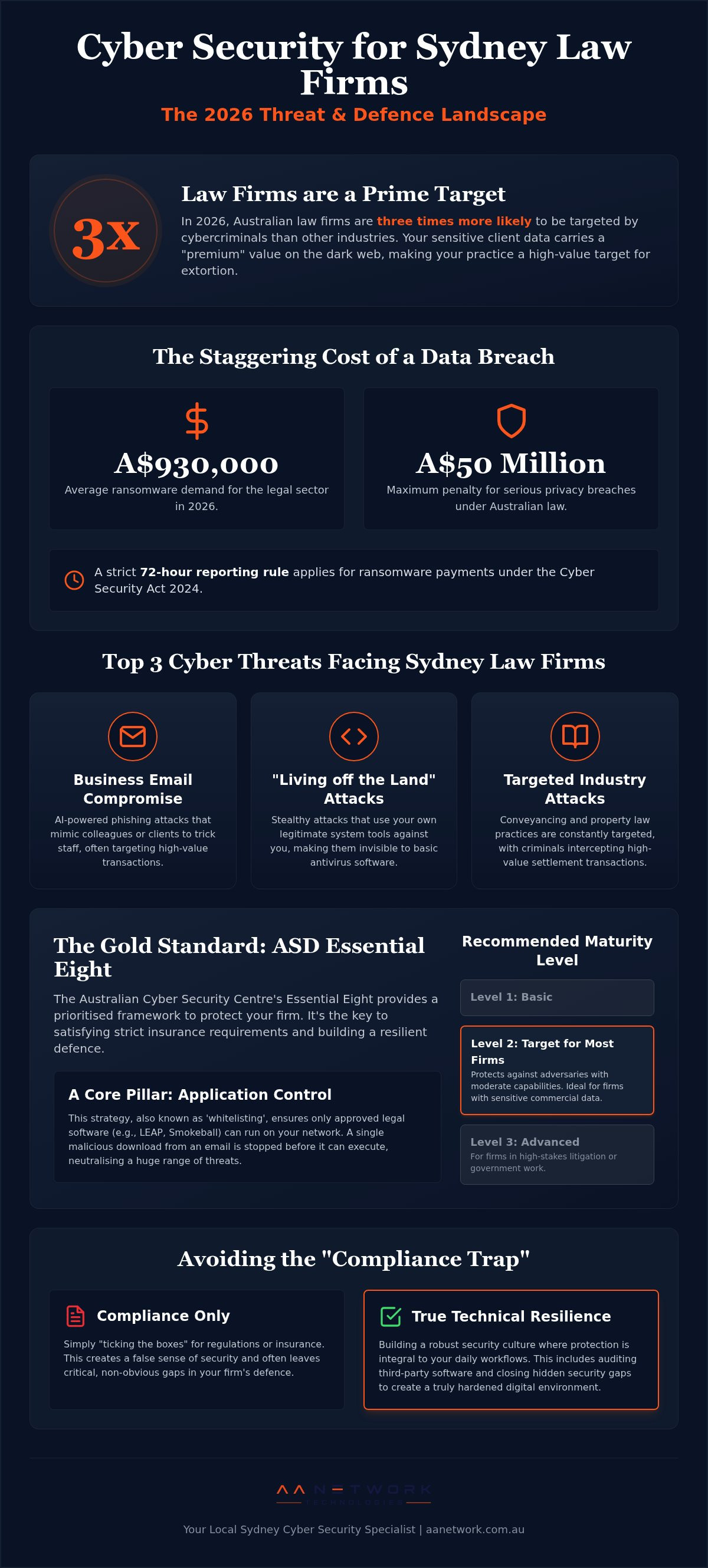
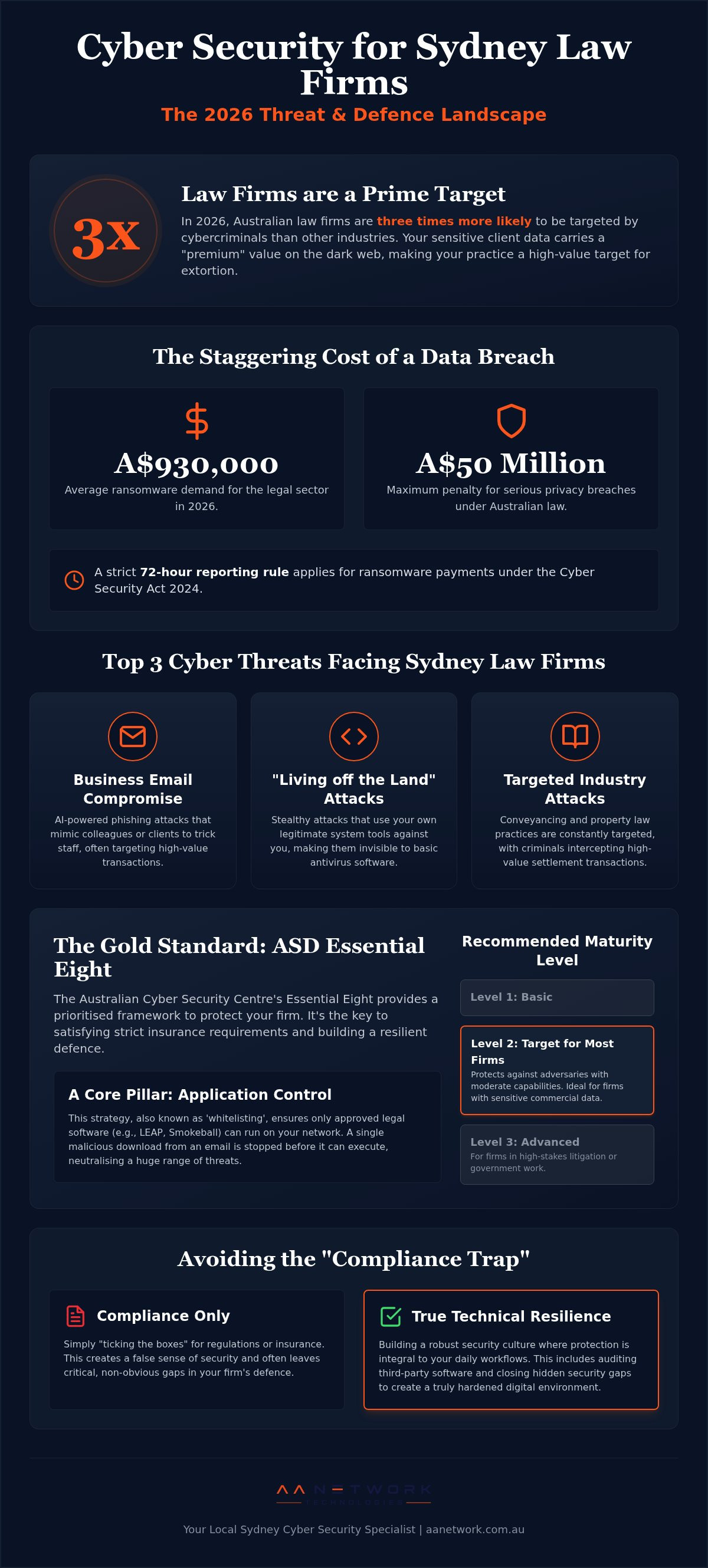
In 2026, the average ransomware demand targeting the legal sector has jumped to approximately A$930,000. Most of these attacks start through sophisticated phishing or business email compromise (BEC). These aren't the clunky, typo-ridden emails of the past. Modern threats use AI to mimic the tone and style of your colleagues or clients. Effective cyber security for law firms Sydney must account for these human-centric vulnerabilities to protect your billable hours and your clients' trust.
The High Cost of Legal Data Breaches in NSW
A single leak can end a century-old Sydney practice. Reputation is your most valuable asset, and it's also the most fragile. Under the NSW Uniform Law, practitioners have a non-negotiable duty to maintain client confidentiality. A breach isn't just a technical failure; it's a professional conduct issue. The financial stakes are equally high. Serious privacy breaches now attract penalties of up to A$50 million or 30% of adjusted turnover. This is no longer a risk you can afford to ignore.
There is also the 72-hour reporting rule under the Cyber Security Act 2024 for ransomware payments. This regulatory pressure is why insurers are tightening the screws. If you don't meet specific security standards, your Professional Indemnity Insurance might not cover the fallout. Understanding the Information Technology Law Overview helps practitioners see that digital security is now a core part of their legal obligations. It's a mandatory requirement for doing business in the modern legal market.
Current Threat Landscape for Sydney CBD Practices
The threats facing Sydney CBD and Parramatta firms are becoming more surgical. Property law and conveyancing practices are under constant fire. Criminals monitor email chains to intercept high-value transactions at the exact moment of settlement. We often see a rise in "Living off the Land" attacks. These don't use obvious viruses. Instead, they use your own system tools against you, making them invisible to basic antivirus software.
Boutique firms in Parramatta are often viewed as "soft targets." Hackers assume these smaller practices lack the robust cyber security for law firms Sydney found in larger international firms. This makes proactive protection essential for firms of every size. Whether you are a sole practitioner or a mid-tier firm, the goal is to create a digital environment where your data is as secure as the physical files in your cabinet.
Essential Cyber Security Frameworks for Legal Practices
Frameworks provide a logical structure to what can otherwise feel like an overwhelming list of tech chores. For cyber security for law firms Sydney, the ASD Essential Eight is the undisputed gold standard. It's a prioritised list of mitigation strategies designed to make it as hard as possible for hackers to compromise your systems. However, it isn't just about ticking boxes. It's about building a "Security by Design" culture where protection is baked into your daily legal workflows.
Most Sydney practices should aim for Maturity Level 2 or 3 within this framework. Level 2 is generally suitable for firms handling sensitive commercial data, while Level 3 is the target for those involved in high-stakes litigation or government work. If you aren't sure where your practice currently sits, a professional IT health check is the fastest way to map your roadmap. It identifies your gaps and gives you a clear path toward technical resilience.
Implementing the Essential Eight in a Legal Environment
The first pillar is Application Control, often called whitelisting. This ensures that only approved legal software, like LEAP or Smokeball, can run on your network. If a staff member accidentally downloads a malicious file, it simply won't execute. This single step can stop most automated attacks in their tracks. Next is Patch Management. Hackers love unpatched software because it provides an easy, well-known way into your system. If your team is clicking "remind me later" on update notifications, you're leaving the vault door unlocked.
Finally, you must restrict administrative privileges. Not every solicitor or clerk needs full access to the firm's entire database or the ability to install new software. By limiting access on a "need-to-know" basis, you contain the damage if an individual account is ever compromised. These core strategies are detailed in the Australian Government Cyber Security Guidelines, which serve as a vital resource for any practice manager.
Multi-Factor Authentication (MFA) and Identity Management
Identity is the new perimeter for modern law firms. In 2026, relying on a password and an SMS code is no longer sufficient. SMS codes can be intercepted through SIM-swapping or sophisticated phishing kits. For robust cyber security for law firms Sydney, you should implement hardware security keys or biometric authentication. These physical tokens ensure that even if a password is leaked, your data remains secure.
Don't forget the "Human Firewall." Your staff are your first and last line of defence. Regular, specialised training helps your team spot the subtle signs of business email compromise (BEC) before they click a link or authorise a payment. When your team understands why these protocols exist, they become active participants in your firm's defence rather than seeing security as a hurdle to their billable hours.
Compliance vs. Technical Defence: What Your Practice Actually Needs
Don't fall into the "Compliance Trap." Meeting the NSW Law Society standards is a vital starting point, but it doesn't make your firm unhackable. Compliance is often about following rules and passing audits; technical defence is about stopping a determined intruder. You can have every required policy in your handbook and still lose a week of billable hours to a ransomware incident. Effective cyber security for law firms Sydney requires a balance between legal checkboxes and actual system hardening that works in a fast-paced office.
Ease-of-use is just as critical as high-level security. If a security measure makes a solicitor's life too difficult, they'll eventually find a workaround that creates a new vulnerability. We focus on making security invisible. This often involves moving data from vulnerable on-site servers to secure, Sydney-based data centres. Cloud migration isn't just about remote work; it's about putting your sensitive client data behind the multi-billion dollar security infrastructure of providers like Microsoft or Amazon. It's a massive upgrade from a server sitting in a dusty office cupboard.
Securing Microsoft 365 for Legal Workflows
Most Sydney firms already use Microsoft 365, but very few have it properly optimised for legal risks. We configure Data Loss Prevention (DLP) to act as a digital safety net. If a staff member accidentally tries to email a sensitive brief to an external party, the system flags or blocks the message. For matters involving extreme confidentiality, we implement encrypted communication channels that move beyond standard email. This ensures only the intended recipient can view the contents. You can find deeper optimisation tips in our guide on Microsoft 365 support Sydney.
Managed IT Support: The Proactive Guardian
Relying on reactive "break-fix" IT is a gamble you won't win. If you only call for help when something stops working, the damage is likely already done. A proactive guardian monitors your network 24/7, catching minor glitches and security gaps before they turn into full-blown crises. In the Sydney CBD, where every minute of downtime directly impacts your bottom line, this proactive approach is essential. While remote support is quick, having a local partner who can physically visit your Sydney or Parramatta office for on-site troubleshooting provides a level of accountability that global call centres simply can't offer. It's about having a specialist who understands your specific workflow and the high stakes of your practice.
Step-by-Step: Hardening Your Firm’s Digital Defences
Hardening your firm's defences isn't a one-off project. It's a series of practical, repeatable steps that build a resilient barrier around your client data. For effective cyber security for law firms Sydney, you need a clear baseline of your current risks. This starts with a comprehensive IT health check to find where your systems are leaking. You can't fix a vulnerability you haven't identified, and in the legal sector, an overlooked gap can be the difference between a normal Tuesday and a catastrophic data breach.
Once you've identified the gaps, you must audit every third-party integration and cloud software used by your team. Many firms are surprised by how much "Shadow IT" has crept into their daily operations. This includes everything from personal cloud storage to unapproved document conversion tools. Every one of these tools is a potential doorway into your network. Formalising your incident response plan is the final piece of the puzzle. This plan should outline the exact technical and legal steps your team must take the moment a threat is detected.
The 30-Minute Security Audit
You don't need a week-long workshop to start improving your posture. A focused 30-minute audit often reveals the most common risks. Start by checking for apps your paralegals or clerks might be using without your knowledge. These "Shadow IT" solutions often lack the encryption standards required for legal work. Next, review your password hygiene. If your firm still uses shared accounts for certain databases or research tools, you're creating a massive security risk. Finally, verify the integrity of your current backup schedule. If you can't prove your backups are running correctly, they don't exist.
Business Continuity and Disaster Recovery
If your system went down right now, how long could your firm stay offline before it stopped being billable? This is your Recovery Time Objective (RTO). A robust disaster recovery plan uses off-site Sydney storage to ensure your data is safe even if your physical office is compromised. This off-site data must be "air-gapped" or immutable so ransomware can't reach it. We've seen too many firms discover their backups were encrypted at the same time as their live files.
Testing your backups is the only way to ensure they'll work when you need them most. A backup is useless if it hasn't been verified in the last 30 days. Regular testing gives you the peace of mind that you can recover quickly from any incident. For more detailed advice on continuity planning, explore our resources on Managed IT Support Sydney. If you're ready to secure your practice, you can book a free 30-minute IT health check to get a professional assessment of your current defences.
Partnering with a Local Sydney Cyber Security Specialist
The days of relying on a general "computer guy" are over. In 2026, the complexity of legal threats requires a specialist who understands the specific nuances of cyber security for law firms Sydney. You need more than just technical support; you need a partner who takes personal ownership of your firm's safety. AA Network Technologies provides this through a founder-led model that prioritises accountability and direct communication. We don't hide behind tickets or automated queues. Our focus is on building a reliable partnership that gives you peace of mind.
When a critical issue arises, a faceless call centre in another time zone is the last thing you need. On-site support is vital for sensitive legal environments in the Sydney CBD and Parramatta. Having a technician who can physically walk into your office ensures that problems are resolved quickly without the friction of remote guesswork. This local presence allows us to understand your physical security and office workflow in a way that a remote provider never could. It's about reducing downtime so your solicitors can stay focused on their clients and their billable hours.
Founder-Led Accountability
Working with a boutique IT firm mirrors the traditional legal partner model. You get direct access to high-level expertise rather than being passed down to a junior staffer in a large, rigid organisation. We believe in transparent pricing and clear dialogue. You won't hear impenetrable technical jargon from us. Instead, we frame every solution in terms of its practical business utility. This personal commitment to the security of the Sydney professional community means AA Network Technologies treats your firm's protection as a promise from one business owner to another. We are allergic to the inefficiencies of larger firms and prefer a straight-talker approach that delivers results without the bureaucracy.
Next Steps for Your Practice
Securing your practice for the 2026 financial year starts with understanding your current baseline. We recommend developing a customised security roadmap that addresses your specific vulnerabilities and growth goals. This proactive approach ensures that your defences evolve as quickly as the threats targeting the legal sector. You don't have to tackle this transition alone. AA Network Technologies acts as your watchful ally, taking on the burden of technical management so you can get back to your primary work. It's time to move from reactive fixes to a proactive stance that shields your reputation and your bottom line.
Ready to harden your defences? Book your free 30-minute IT health check today with AA Network Technologies to identify your risks and start building a more resilient practice with a local partner you can trust.
Future-Proof Your Practice with Local Expertise
Securing your practice in 2026 requires more than a standard compliance checklist. It's about moving from passive reporting to building a proactive technical shield around your client data. By implementing the ASD Essential Eight and hardening your digital environment, you protect your hard-earned reputation and your firm's billable hours. Effective cyber security for law firms Sydney isn't just about avoiding fines; it's about ensuring your office remains operational no matter what the threat landscape looks like.
You shouldn't have to manage these technical burdens alone. Our founder-led team provides specialised support for legal firms with on-site assistance across the Sydney CBD and Parramatta. We offer the personal accountability that global call centres simply can't match. It's time to replace technical confusion with the peace of mind that comes from a reliable, local partnership.
Secure your practice today with a free 30-minute IT health check. Let's work together to keep your firm safe, compliant, and ready for whatever comes next.
Frequently Asked Questions
Is my Sydney law firm legally required to follow the Essential Eight?
While the Essential Eight isn't a strict legal mandate for every private firm, it's the baseline standard expected by the NSW Law Society and most cyber insurers in 2026. Failing to implement these controls can lead to denied insurance claims or professional negligence findings after a breach. It acts as your primary technical defence, stopping the vast majority of common cyber attacks before they reach your data.
How much should a mid-sized law firm in Sydney spend on cyber security?
Most Sydney firms allocate roughly 10% to 15% of their total IT budget toward security, though this varies based on your specific risk profile. Instead of focusing on the upfront cost, consider the alternative: the average ransomware demand for the legal sector has risen to A$930,000. Investing in proactive cyber security for law firms Sydney is significantly cheaper than managing a total practice shutdown.
Does professional indemnity insurance cover cyber attacks in NSW?
Standard professional indemnity insurance often excludes or limits coverage for cyber incidents unless you have a specific cyber extension or standalone policy. Insurers in 2026 are increasingly strict, often refusing to renew policies for firms that cannot demonstrate Maturity Level 2 of the Essential Eight. You must check your policy wording to ensure it covers incident response, data recovery, and third-party liability.
What is the most common cyber threat facing Sydney solicitors today?
Business Email Compromise (BEC) remains the most frequent threat, where hackers intercept email chains to redirect settlement funds. They often target property law firms during high-value transactions. These attacks are difficult to spot because they don't use malware; they use stolen credentials to mimic the legitimate tone of a solicitor or conveyancer to authorise fraudulent payments.
Can I use Microsoft 365 to meet legal data privacy requirements?
Microsoft 365 can meet strict privacy standards, but it's rarely compliant "out of the box." You must configure advanced features like Data Loss Prevention (DLP) and conditional access policies to protect sensitive briefs. When optimised by a specialist, it provides a secure, Sydney-based cloud environment that satisfies both the Privacy Act and the NSW Uniform Law requirements for data protection.
Why is on-site IT support better for law firms than remote-only help?
On-site support provides a level of physical security and accountability that remote-only call centres can't offer. A technician visiting your Sydney CBD or Parramatta office can identify "Shadow IT" hardware and secure your physical server room effectively. This high-touch approach ensures your specific legal workflows are protected without the delays of waiting in a global support queue during a crisis.
What should I do first if I suspect my law firm has been hacked?
You should immediately disconnect the affected devices from the network and contact your cyber security partner. Don't attempt to "clean" the system yourself, as you might destroy forensic evidence needed for insurance or regulatory reports. Under the Cyber Security Act 2024, you may have only 72 hours to report a ransomware payment or incident to the Australian Government.
How often should we conduct cyber security training for our legal staff?
Training should be an ongoing process rather than a once-a-year event. We recommend quarterly sessions and regular phishing simulations to keep security at the front of your team's mind. Because over 50% of Australian organisations reported AI-powered threats in 2025, your staff must stay updated on how to spot increasingly convincing deepfakes and automated phishing attempts that bypass traditional filters.