
Small Business Cyber Security Cost Australia: 2026 Pricing Guide
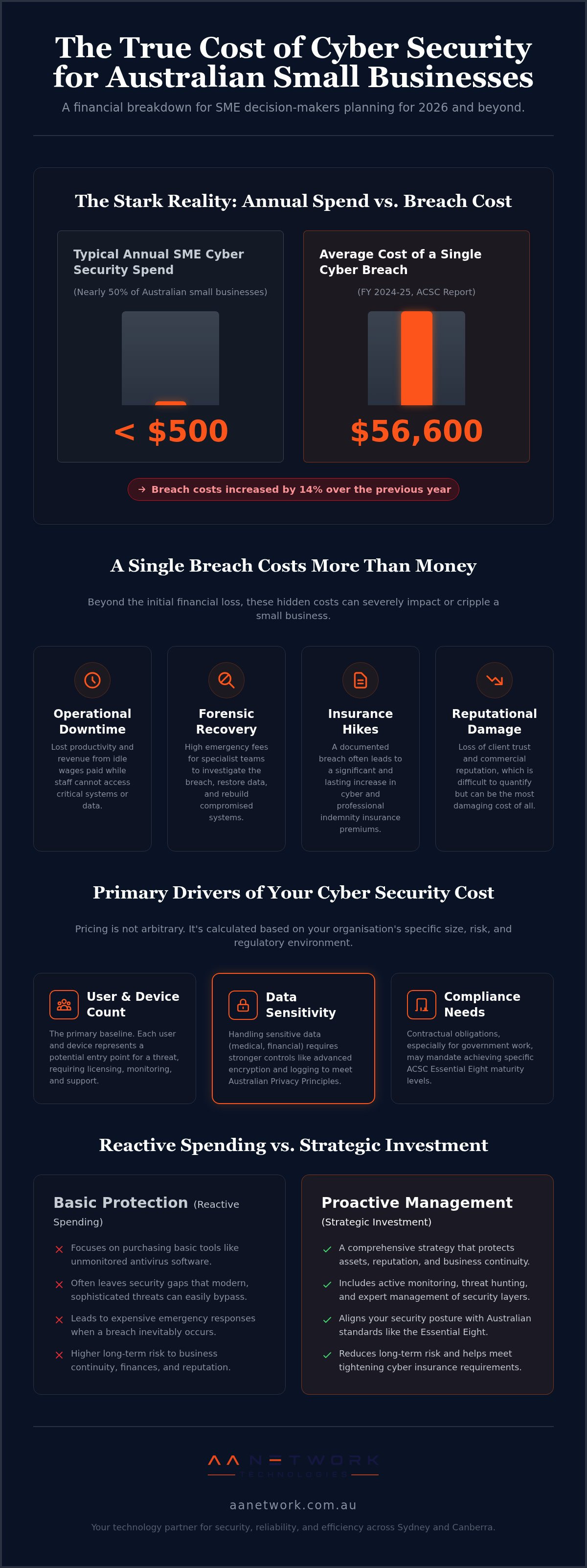
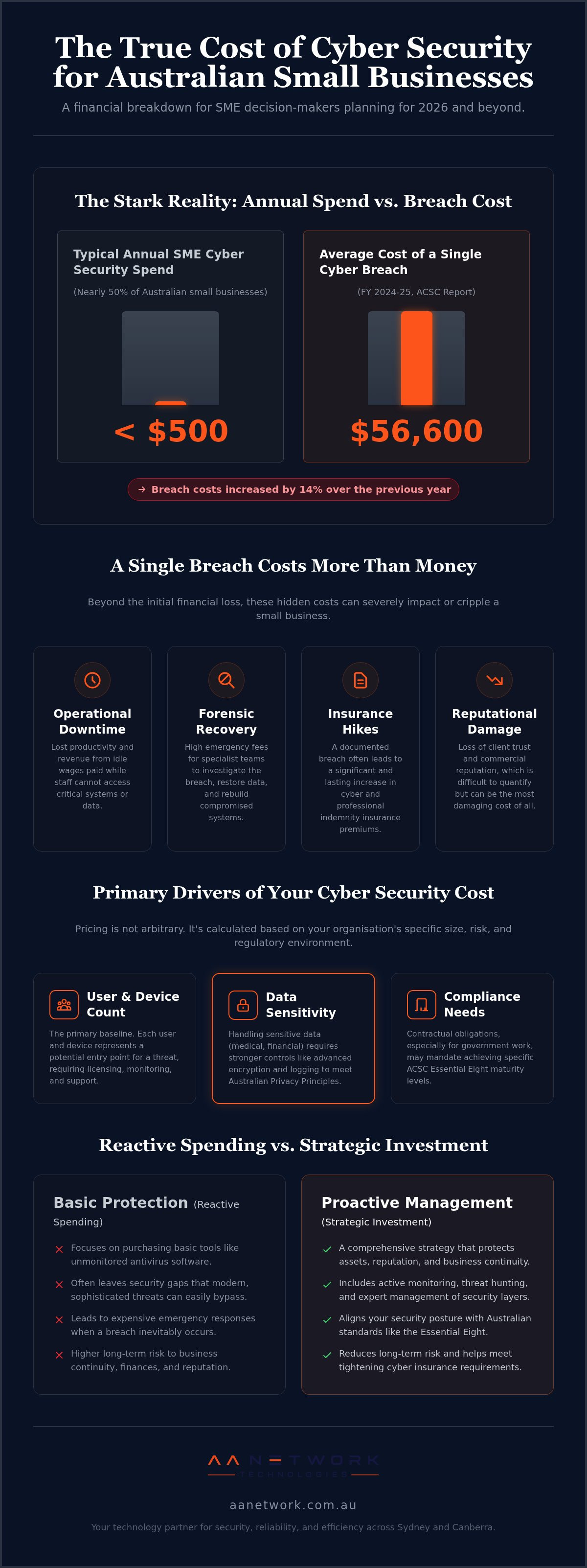
Nearly half of all Australian small businesses spend less than $500 a year on cyber security. It is a concerning figure when you consider that the average cost of a single cyber incident for an Australian small business rose to $56,600 in the 2024-25 financial year. Most owners know they need better protection, but determining the actual small business cyber security cost Australia requires is often a frustrating exercise in navigating vague quotes and technical jargon.
You likely feel the pressure of rising cyber insurance premiums and the confusion of choosing between a basic antivirus and a comprehensive managed service. We understand that you need clear numbers to plan your financial year with confidence. This guide provides a transparent breakdown of cyber security investment levels, the primary drivers behind pricing, and the financial risks associated with data breaches.
We will explore how to align your budget with the Essential Eight framework and ensure your organisation remains compliant with Australian privacy principles. By the end, you will have a practical framework to secure your business without overpaying for unnecessary extras.
Key Takeaways
- Understand the distinction between reactive technology spending and a strategic security investment that protects your commercial reputation and business continuity.
- Identify the specific variables, such as user numbers and regulatory requirements, that determine the small business cyber security cost Australia companies should budget for in 2026.
- Learn how to align your IT environment with the ACSC Essential Eight framework to meet tightening cyber insurance requirements and improve operational resilience.
- Compare the "Basic Protection" and "Proactive Managed" models to find a security framework that fits your specific industry and risk profile.
- Discover how a local, practitioner-oriented service model in Sydney CBD or Parramatta provides better accountability and faster response times than automated call centres.
The Financial Reality of Small Business Cyber Security in Australia
Viewing cyber security as a defensive tax is a common mistake. It's more accurate to view it as a strategic investment in your company's resilience and reputation. While spending focuses on the immediate purchase of tools, investment considers the long-term protection of your assets and the prevention of operational downtime. For many organisations, the small business cyber security cost Australia requires is simply the price of staying in business.
Australian Cyber Security Centre (ACSC) highlights the stakes involved. The average self-reported cost for a cyber incident for an Australian small business reached $56,600 in the 2024-25 financial year.
The total small business cyber security cost Australia owners must plan for is the sum of software licensing, managed services, and internal staff training. Failing to account for all three often leads to gaps that attackers are quick to exploit.
Breach Costs vs. Prevention Costs
A single breach often costs more than several years of proactive managed cyber security. Beyond the immediate financial loss, hidden costs can cripple a small firm. You must account for idle wages paid while staff cannot access systems, the high fees of forensic recovery teams, and the eventual hike in professional indemnity insurance premiums. For firms in Sydney CBD, these insurance costs are increasingly tied to proven security maturity.
Opting for "cheap" security is often the most expensive path you can take. Basic antivirus software without active monitoring leaves you vulnerable to modern threats that bypass traditional signatures. When a breach occurs, the cost of emergency response and system rebuilding far outweighs the monthly fee of a comprehensive security partner.
Why Australian SMEs are Targeted in 2026
Cybercriminals often view small businesses as low-hanging fruit. They assume smaller organisations lack the sophisticated defences of a major bank but still hold valuable data. Legal and accounting firms in Parramatta and Sydney CBD are prime targets because they manage sensitive client financial records and identity documents. This data is highly liquid on the dark web and provides a high return on investment for attackers.
We are seeing a significant rise in business email compromise (BEC) targeting local supply chains. Attackers intercept invoice communications and redirect payments to fraudulent accounts. Because these attacks rely on social engineering rather than just technical exploits, they can bypass basic security layers. Protecting your business requires a combination of technical controls like MFA and a culture of security awareness among your team.
Primary Drivers of Cyber Security Pricing for SMEs
User count and device numbers form the primary baseline for most subscription-based pricing models in Australia. It's a logical starting point because each user represents a potential entry point for a threat. Managing ten identities is simpler and less resource-intensive than managing a hundred. Most managed service providers use these numbers to calculate the level of monitoring and support required to keep an organisation secure.
Data sensitivity and regulatory requirements also play a massive role. If you handle sensitive patient records in the medical sector or financial data in accounting, your compliance obligations under the Australian Privacy Principles are higher. This often necessitates more rigorous encryption, advanced threat hunting, and detailed logging. These requirements naturally influence the small business cyber security cost Australia businesses must account for in their annual budgets.
For firms in Canberra or Sydney CBD bidding on government work, achieving specific Essential Eight maturity levels isn't optional. It's a contractual requirement. Meeting these standards involves specific technical controls and documentation that shift the budget from basic protection to advanced compliance. You can find more official guidance on cyber security for your business to understand these baseline expectations and how they apply to your industry.
The Role of User Lifecycle Management
Effective security starts with knowing who has access to your systems. Onboarding and offboarding processes are critical. If a former employee still has access to your Microsoft 365 environment, your risk profile increases significantly. We use tools like Microsoft Entra ID and Intune to automate these digital identities and ensure "least privilege" access is maintained. This means staff only have access to the specific data they need to do their jobs. It's a practical way to reduce your attack surface without necessarily increasing your software spend.
Infrastructure and Network Complexity
Your physical and digital environment also dictates pricing. A single office in Parramatta with a cloud-only setup is simpler to secure than a multi-site operation with a hybrid mix of on-premise servers and Azure cloud services. Budgeting for hardware refreshes is essential. Old firewalls, switches, and Wi-Fi access points often lack the firmware updates needed to block modern exploits.
Integrating secure remote access for staff working from home in Greater Sydney adds another dimension to the cost. It's no longer enough to secure the office perimeter; you must secure the connection from the kitchen table to the corporate network. If you're unsure where your current infrastructure stands, you can speak with our team for a practical assessment of your environment.
Comparing Cyber Security Investment Models
Choosing a security framework depends on your risk tolerance and industry obligations. Most firms fall into one of three categories. The Basic Protection model covers the essentials like antivirus and standard backups. It's a starting point but often fails to meet the tightening criteria of Australian cyber insurance providers in 2026. The Proactive Managed model introduces 24/7 monitoring and advanced endpoint protection, which is the current standard for professional services. Finally, the Compliance-Driven model is for those needing full Essential Eight alignment, involving regular restore testing and strict access controls.
A DIY approach is tempting but often leaves critical gaps in Microsoft 365 optimisation. We often see businesses with licenses that aren't configured for security. They might have MFA enabled but lack the conditional access policies or Intune configurations needed to truly protect their data. This oversight can lead to a higher small business cyber security cost Australia owners face when they eventually have to remediate a breach. Professional management ensures these tools are working as intended from day one.
Managed Security Services (MSSP) Pricing
For professional services in Sydney, a monthly retainer is the most common structure. This subscription fee typically includes continuous monitoring, patch management, and help desk support. It provides a predictable cost for the financial year and allows for better budget planning. The value of local on-site support in business hubs like North Sydney and Macquarie Park cannot be overstated. Having a technician who can physically visit your office reduces downtime when hardware issues arise or complex network changes are required.
Project-Based vs. Ongoing Security Costs
You should distinguish between one-off capital expenditure (CapEx) and ongoing operational expenditure (OpEx). Project-based costs include cloud migrations or the initial implementation of MFA across your organisation. These are essential foundations. However, security is not a "set and forget" task. Security awareness training and regular system audits should be treated as ongoing operational expenses. This ensures your defences remain effective as threats evolve, rather than relying on outdated hardware or configurations.
When calculating the total small business cyber security cost Australia requires, consider the ROI of managed cyber security. It is often more cost-effective to pay a monthly fee for proactive monitoring than to pay emergency ad-hoc rates when a system fails. A managed approach provides a proactive guardian for your network, allowing your team to focus on their primary work without the distraction of technical management or the fear of a sudden data breach.
Budgeting for Essential Eight and Australian Standards
Building a security budget is a structured process that starts with identifying your specific vulnerabilities. Determining the small business cyber security cost Australia requires in 2026 involves more than just buying software; it's about aligning with the ACSC strategies. We recommend a five-step approach to ensure your investment is targeted and effective.
- Step 1: Conduct an initial environment review. Use a free IT health check to identify security gaps and shadow IT within your organisation.
- Step 2: Prioritise the most cost-effective controls. Implementing multi-factor authentication (MFA) and verifying backup retention policies provides the highest immediate return on investment.
- Step 3: Implement endpoint management. Use Microsoft Intune to standardise security policies across all company laptops and mobile devices.
- Step 4: Establish a regular schedule for maintenance. This includes automated patching of applications and monthly testing of your data restoration procedures.
- Step 5: Review the budget quarterly. Adjust your spending based on emerging threat patterns and changes in your staff numbers or office locations.
For a small business with 25 to 75 employees, a realistic first-year budget to implement Essential Eight Maturity Level One typically ranges between $15,000 and $60,000. An initial gap analysis for a smaller firm generally costs between $900 and $2,500. These figures represent the foundational small business cyber security cost Australia firms must plan for to achieve a baseline level of resilience.
Maturity Levels and Financial Impact
Maturity Level 1 is the minimum baseline for most Australian SMEs. It focuses on basic protections against opportunistic attacks. Reaching Maturity Level 3 requires a higher investment in automation and continuous monitoring to defend against more targeted threats. This level of security is often necessary for businesses in legal or medical sectors that handle highly sensitive data. If you need assistance with these technical requirements, our Managed Cyber Security Sydney team can provide local implementation support.
Compliance for Professional Services
Law firms and accounting practices in NSW face specific requirements from professional bodies and insurers. You must ensure your security budget accounts for the Australian Privacy Principles, particularly regarding data breach notification and secure storage. Using a practitioner-led model ensures your compliance is documented and verifiable. This proactive approach reduces the risk of regulatory fines and reputational damage following a security incident.
Optimising Your Security Spend with AA Network Technologies
Managing the small business cyber security cost Australia requires is more than a technical challenge; it's a commercial one. At AA Network Technologies, we operate a senior-led, practitioner-oriented model. Our focus is on providing a high-touch alternative to the faceless, automated services offered by larger IT conglomerates.
Choosing a local partner in Sydney CBD or Parramatta significantly reduces the risk of costly downtime. When a critical hardware failure occurs or a security incident is detected, having a technician who can visit your site provides immediate relief. Remote call centres often struggle with the nuances of local infrastructure or the specific pressures of an Australian professional services firm. We take personal ownership of your systems so you can focus on your primary work.
Integrating your managed IT support with your security services creates better value than using siloed providers. When one team handles your Microsoft 365 environment, your network, and your security protocols, there are fewer gaps for attackers to exploit. This unified approach ensures that every software update and configuration change is made with your overall security posture in mind.
Practical Outcomes Over Technical Jargon
We translate technical risks into business consequences that make sense for your bottom line. Instead of focusing on specifications, we discuss your Recovery Time Objective (RTO) and Recovery Point Objective (RPO). These metrics define how quickly your business can resume operations and how much data you can afford to lose. Planning your budget around these outcomes ensures you aren't overpaying for gold-plated solutions where a standard, reliable backup would suffice.
Starting Your Security Journey
Getting a realistic estimate for your small business cyber security cost Australia doesn't have to be a complicated process. We offer a IT & Cyber Security Review to review your current environment and identify immediate risks. This session provides a practical roadmap tailored to the specific needs of law firms, medical practices, and accounting offices across Sydney and Canberra. It's the first step in moving from reactive spending to a proactive security strategy.
You shouldn't have to guess which security controls are essential for your compliance. We provide clear, accountable recommendations that align with the Australian Privacy Principles and the Essential Eight framework. Contact AA Network Technologies today to speak with a specialist about securing your organisation's future.
Securing Your Business Continuity for the Financial Year
Managing the small business cyber security cost Australia requires is a balance between technical necessity and commercial reality. We've explored how shifting from a reactive spending mindset to a proactive investment model protects your commercial reputation. By aligning with the Essential Eight and optimising your Microsoft 365 environment, you meet tightening insurance criteria while ensuring your team remains productive.
Our senior-led team provides the specialised, local support that faceless call centres cannot match. With offices in Sydney CBD and Parramatta, we offer practitioner-oriented strategies that focus on your specific industry risks. We take on the burden of technical management so you can focus on your primary work with complete peace of mind.
Taking the first step toward a more secure environment is a promise to your clients and your staff. We're here to act as your proactive guardian and reliable technology partner.
Frequently Asked Questions
What is the average monthly cost for managed cyber security in Australia?
Managed IT support pricing in Australia typically ranges from $149 to $349 per user per month in 2026. This rate generally includes security monitoring, help desk access, and patch management. For a Sydney small business, the exact figure depends on the complexity of your network and the sensitivity of your data. Investing in a per-user model provides a predictable monthly expense that simplifies your long-term financial planning.
Does cyber insurance replace the need for a cyber security budget?
Cyber insurance is a risk transfer tool, not a replacement for a security budget. In 2026, most Australian insurers won't issue a policy unless you can prove you have baseline controls like MFA and regular backups in place. Think of insurance as the safety net and cyber security as the preventative measures. You need a dedicated budget for both to ensure your business remains resilient and insurable under modern underwriting standards.
How much does it cost to implement the Essential Eight for a small business?
A realistic first-year budget for a small business to reach Essential Eight Maturity Level One is between $15,000 and $60,000. This includes the implementation of all eight strategies, from application control to daily backups. While this is a significant part of the small business cyber security cost Australia companies face, it is a fraction of the $56,600 average cost of a single cyber incident reported by the ACSC.
Is Microsoft 365 secure enough for my business without extra spending?
Microsoft 365 provides a robust security platform, but it isn't fully optimised by default. Most standard business licenses require professional configuration of Entra ID, Intune, and conditional access policies to be effective. Without these adjustments, you may leave gaps in your identity management and device security. Optimising your existing tenant is often more cost-effective than purchasing third-party tools that duplicate features already included in your Microsoft 365 subscription.
Can I reduce my cyber security costs by using a call centre-based IT provider?
Call centre-based providers often offer lower monthly rates, but they frequently lead to higher long-term expenses through increased downtime and slower response times. A local, practitioner-led partner in Sydney CBD or Parramatta provides the accountability that automated systems lack. In a security incident, the time taken to reach a qualified specialist is the difference between a minor disruption and a total business shutdown. Local expertise is an investment in operational reliability.
What are the most cost-effective cyber security measures for a startup?
Startups can achieve high resilience by focusing on three cost-effective areas. First, enable Multi-Factor Authentication (MFA) on all accounts. Second, implement a tested, off-site backup solution. Third, conduct regular staff security awareness training. These steps significantly lower the small business cyber security cost Australia startups face while protecting against the most common threats like phishing and business email compromise. It builds a secure foundation for growth without overextending your initial budget.
How often should a Sydney small business review its cyber security budget?
You should review your cyber security budget at least quarterly. The threat landscape in Australia changes rapidly, and your internal requirements may shift as you hire new staff or move to new office locations in Western Sydney. A quarterly check ensures your spending remains aligned with your actual risk profile and current ACSC recommendations. Regular reviews also prevent your business from paying for legacy tools that no longer provide meaningful protection.
What is the cost of a cyber security audit for a professional service firm?
A foundational Essential Eight gap analysis for a small business generally costs between $900 and $2,500. For professional service firms in Macquarie Park or Chatswood, this review identifies where your current defences fail to meet Australian standards. The audit results allow you to prioritise your spending on the most critical vulnerabilities first. It is a necessary step for meeting the compliance requirements of legal, medical, and financial sectors.
Sources and further reading
- Essential Eight, Australian Signals Directorate
- Notifiable Data Breaches scheme, OAIC
- Microsoft 365 security documentation, Microsoft Learn
- Backups, Australian Signals Directorate
Reviewed by AA Network Technologies, October 2026. This article provides general information, not legal advice.
Book an IT & Cyber Security Review or talk to our Managed IT team.