

Presenting IT Proposals: 2026 Guide for Sydney SMEs
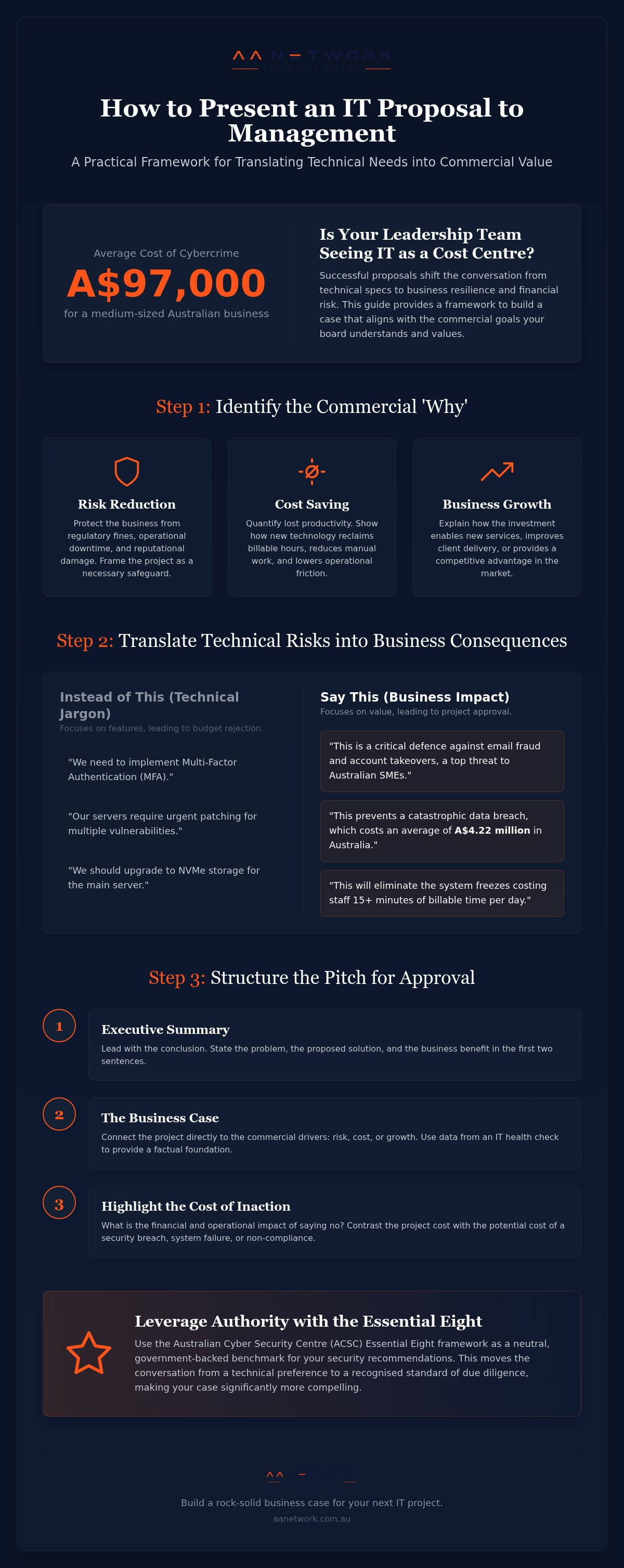
The average self-reported cost of cybercrime for a medium-sized Australian business has risen to A$97,000. For most Sydney SMEs, this isn't just a technical hurdle; it's a significant threat to the bottom line. It's frustrating when you know a project is essential for security or efficiency, but your leadership team only sees IT as a cost centre. You've likely felt the sting of a budget rejection simply because the ROI wasn't clear to those holding the purse strings.
Successful IT leaders know that presenting an IT proposal to management requires a shift in language. Instead of talking about patches and protocols, you must focus on business resilience and financial risk. This 2026 guide provides a practical framework for translating complex technical requirements into the commercial value your board actually cares about. We'll explore how to align your technology roadmap with business goals and use Australian security standards like the Essential Eight to build a case that's impossible to ignore.
Key Takeaways
- Identify the primary business driver behind your project to ensure it aligns with the commercial goals of the leadership team.
- Master the structure for presenting an IT proposal to management by leading with a concise executive summary and a clear business case.
- Translate complex technical risks into plain English consequences like financial loss, reputational damage, and operational downtime.
- Prepare for budget objections by highlighting the cost of inaction, especially regarding cyber security and Australian privacy regulations.
- Utilise data from a professional IT health check to provide a factual foundation for your recommendations and build executive trust.
Preparing Your IT Proposal: Understanding the Commercial Why
An IT proposal is often mistaken for a technical shopping list. In reality, it's a commercial document designed to justify a technology investment. When you're preparing for the task of presenting an IT proposal to management, you must pivot from thinking like a technician to thinking like a business owner. This means understanding the business case behind every server upgrade or software migration. Management teams don't buy "faster processors"; they buy reduced employee frustration and protected profit margins.
The commercial 'Why' serves as the essential bridge that connects technical specifications to business profitability. If you can't explain how a project helps the firm make money, save money, or stay out of legal trouble, the proposal will likely fail. You need to identify whether your primary driver is risk reduction, cost saving, or business growth before you even open a slide deck.
Identifying the Business Drivers for Your Project
For a professional service firm in Sydney CBD or Parramatta, operational friction is a silent profit killer. If your staff lose fifteen minutes a day to slow login times or legacy software crashes, that's hours of billable time lost every week. Your proposal should quantify this lost productivity. If the project addresses a compliance gap, such as meeting the Australian Privacy Principles (APP), frame it as a mandatory safeguard against regulatory fines and reputational damage.
You must also evaluate the cost of inaction. If management rejects the budget for a new backup system, what's the financial impact of a 48-hour outage? In the Australian market, where the average cost of a data breach is now A$4.22 million, the risk of doing nothing often outweighs the cost of the project itself. Use these figures to show that your proposal is a proactive defence of the company's assets.
Knowing Your Audience: From CFO to Managing Director
When presenting an IT proposal to management, you're often speaking to people with very different priorities. The CFO wants to see the long-term ROI. They'll be looking at the balance between capital expenditure (CAPEX) and operating expenses (OPEX). Be ready to explain how moving to a cloud-based model like Microsoft 365 can turn unpredictable hardware costs into a steady, manageable monthly fee.
The Managing Director has a different focus. They care about business continuity and the firm's reputation in the Sydney market. They want to know that a cyber attack won't put the business on the front page of the news or lead to an OAIC investigation. In a typical Sydney legal or accounting firm, you also need to identify the key influencers. This might be a senior partner who is particularly frustrated by current system limitations. Winning their support early can make the formal approval process much smoother.
Translating Technical Risks into Business Consequences
Technical jargon is a significant barrier to budget sign-off. When you're presenting an IT proposal to management, your primary job is to strip away the specifications and focus on the operational impact. Management doesn't need to understand the intricacies of NVMe storage or low-latency switching. They need to know that these upgrades prevent the system freezes that stop your team from working and billing clients.
Technical debt is a concept that resonates well with business owners. Like a high-interest credit card, technical debt accumulates when you ignore old hardware or outdated software. The longer you wait to replace a failing server or migrate to the cloud, the higher the eventual cost of data recovery and emergency migration. Frame your proposal as a way to pay down this debt before the interest-in the form of system failure-becomes too high to manage.
When presenting an IT proposal to management, frame Microsoft 365 optimisation as a tool for reclaiming lost billable hours. If your Sydney-based legal or medical team can collaborate on documents in real-time without versioning errors, they're more productive. This isn't just a technical upgrade; it's a direct improvement to the firm's daily output and service delivery.
Cyber Security and the Essential Eight Framework
Australian business leaders are increasingly aware of cyber threats, but they often find technical security details alarmist. Use the Australian Cyber Security Centre (ACSC) Essential Eight framework to provide a neutral, government-backed benchmark. Explain that implementing Multi-Factor Authentication (MFA) and conditional access isn't just a technical preference. It's a critical defence against Business Email Compromise (BEC), which remains a top reported threat for Australian SMEs. View managed cybersecurity as a form of reputational insurance that protects the trust you've built with your clients.
Downtime and Productivity Loss Calculations
Numbers command respect in the boardroom. A key part of getting IT projects approved is providing a clear calculation of downtime costs. Use a simple formula to make your case: (Number of affected staff x Average hourly rate x Estimated productivity loss percentage) = Hourly cost of an outage. This turns an abstract technical risk into a concrete financial figure that a CFO can easily understand.
If a system failure costs your Parramatta office A$5,000 per hour, a four-hour outage pays for most network switching upgrades. Compare this to the latest ASD data, which shows the average cost of cybercrime for a medium-sized Australian business has risen to A$97,000. If you're unsure how to calculate these risks for your specific environment, talking to an experienced consultant can help you gather the necessary data to build a compelling business case.
Structuring the Pitch: A Framework for IT Project Approval
Presenting an IT proposal to management requires a clear, logical structure that removes any ambiguity about what you're asking for and why. A common mistake is burying the lead under twenty pages of technical architecture. Your proposal should follow a briefing format that respects the reader's time and focuses on the commercial destination. Busy executives in Sydney or Parramatta don't have time to dig through complex diagrams; they need to see a path to a better business outcome.
Start with a concise executive summary. This single page should highlight the total A$ investment required and the primary business benefit. If the Managing Director only reads this page, they should understand exactly how the project improves the firm's bottom line. Follow this with a "Current State vs. Future State" comparison. This contrast makes the benefits of the project tangible by showing how specific daily frustrations in your office will be resolved through the investment.
The Executive Summary and Problem Statement
A compelling problem statement identifies a specific bottleneck in your current workflow. Instead of saying "our servers are old", say "our current hardware causes three hours of unplanned downtime per month for the accounting team". This frames the issue as an operational failure rather than a technical preference. State your solution clearly, avoiding brand-led marketing hype or filler. Your summary should include three specific outcomes for quick scanning:
- Elimination of daily system freezes for the staff in your Sydney CBD office.
- Alignment with the ACSC Essential Eight security standards to protect client data.
- Reduction in monthly maintenance costs through consolidated software licensing.
Solution Architecture and Implementation Roadmap
Management's biggest fear is often the disruption caused by the change itself. You must include a high-level timeline that breaks the project into manageable phases. If the project involves a cloud migration, explain how data will be moved after hours or in stages to ensure staff can keep working. This roadmap provides the leadership team with the peace of mind that you've considered the human element of the transition and have a plan to minimise downtime.
Finally, detail the resources required. Be transparent about the internal staff time needed for testing and training. If you're leveraging external managed IT support, explain how this partnership reduces the burden on your internal team and ensures a professional rollout. Providing a clear post-implementation support plan reassures management that the system will remain stable and secure long after the initial setup is complete.
Managing the Meeting: Objections and Local Requirements
The meeting is where many proposals stall. When you're presenting an IT proposal to management, you should expect pushback on costs and implementation timelines. A savvy Sydney business owner isn't just looking at the price tag; they're looking at the risk of disruption to their daily operations. You need to be ready to pivot from technical specifications to commercial safeguards. Preparation is the key to turning a sceptical board into a supportive one.
The most common objection is that the project is too expensive. Counter this by highlighting the financial reality of modern cybercrime in the Australian market. With the average cost of a data breach in Australia reaching A$4.22 million, the investment in your proposal is a fraction of the potential loss. Mentioning IT consulting as a method to validate these costs ensures you're following industry best practice rather than just purchasing new hardware.
Local requirements often come up during the Q&A. Management might ask about data residency, especially if your firm handles sensitive client information in the legal or medical sectors. You should confirm that data remains within Australian borders, typically in Microsoft's Sydney or Melbourne data centres. This alignment with local infrastructure needs shows you've considered the firm's specific geographical and regulatory context. It also demonstrates that your plan supports the firm's growth plans for scaling across the Sydney market.
Handling Common Management Objections
Staff training is a frequent concern for leadership teams. Management often worries that new technology will cause a dip in productivity as people struggle to learn new systems. Explain that your project integrates with the existing Microsoft 365 environment, which minimises the learning curve for staff. Be clear about the budget impact. Show whether this is a one-off capital expense or a predictable monthly operational cost that fits into the current year's financial plan. Addressing these logistical hurdles early removes the friction that often leads to a "no".
Aligning with Australian Compliance Standards
Professional authority is built on referencing official sources. Mention the Australian Signals Directorate (ASD) and the ACSC when discussing your security protocols. This provides a government-backed justification for your choices. Explain how the proposal helps the firm meet its obligations under the Privacy Act, particularly with the stricter requirements signalled in the 2026 exposure draft. Leaders in professional sectors like finance or law are highly sensitive to these compliance risks.
Robust backup and disaster recovery isn't just a technical safety net; it's a regulatory requirement for many Sydney firms. If a ransomware event occurs, your ability to recover data within a 72-hour notification window is critical for legal compliance. Frame this part of the proposal as a proactive measure to protect the firm's reputation and its clients' trust. When you're presenting an IT proposal to management, connecting technical resilience to legal safety is a powerful way to secure final approval.
Partnering for Success: How AA Network Technologies Supports Your Proposal
Presenting an IT proposal to management is often a lonely task for an internal manager or business owner. You know the technical needs, but having an external expert validate your strategy adds a layer of professional authority that leadership teams respect. AA Network Technologies acts as your practical partner, turning technical requirements into a commercially sound business case. We provide the data you need to justify the investment, starting with a professional IT health check that uncovers hidden risks and productivity bottlenecks.
Our founder-led approach means you aren't dealing with a faceless call centre. Ronit Sriwastav and our team bring over 10 years of experience to every project, offering a level of personal investment that larger, rigid organisations simply can't match. For firms in the Sydney CBD or Parramatta, this means having a responsive ally who understands the high stakes of your specific industry. We take on the burden of technical management so you can focus on your primary work with peace of mind.
Professional IT Consulting for Sydney Firms
Strategic planning and project scoping are where most IT projects succeed or fail. We assist Sydney firms by conducting a thorough audit of their current environment to support their internal budget requests. This third-party validation often provides the final piece of evidence a CFO needs to sign off on a project. Whether you're looking at cloud migration or a security overhaul, our IT support in Parramatta and Sydney CBD ensures you have hands-on help during the critical implementation phase.
From Health Check to Managed Implementation
A successful proposal is only the beginning. Once you have approval, the focus shifts to a rollout that doesn't disrupt your staff's daily output. AA Network Technologies manages the entire implementation roadmap, from hardware procurement to post-setup support. We recommend booking a 30-minute environment review to establish a factual foundation for your next board meeting. This review provides a clear, plain-English report on your current security posture and operational efficiency.
If you're ready to build a more resilient technology foundation for your business, you can contact AA Network Technologies for a practical recommendation. We'll help you draft a proposal that aligns with Australian standards and speaks the language of your leadership team. Our team ensures that every technical decision is backed by a clear business outcome, helping you secure the budget sign-off you need for your next project.
Securing Approval for Your Next Technology Project
Successful technology investment starts with a shift in perspective. By focusing on business outcomes rather than hardware specifications, you turn a technical request into a compelling commercial case. Master the art of presenting an IT proposal to management by quantifying the cost of downtime and aligning your strategy with government-backed standards like the Essential Eight. Providing your leadership team with a clear roadmap that contrasts your current state with a more efficient future state removes the ambiguity that often leads to budget rejection.
AA Network Technologies provides the founder-led expertise you need to validate these plans. With over 10 years of experience in the Sydney ICT sector, we offer hands-on, on-site support for firms in the Sydney CBD and Parramatta. Our team acts as a proactive guardian, ensuring your technology roadmap is both secure and commercially sound. We take on the burden of technical management so you can focus on driving your business forward with confidence.
We're ready to help you build a more resilient and profitable business foundation for the years ahead.
Frequently Asked Questions
How do I structure an IT proposal for a small business?
A small business IT proposal should follow a commercial briefing format rather than a technical manual. Start with a one-page executive summary that leads with the business outcome. Follow this with a clearly defined problem statement, the proposed solution, a financial breakdown, and a timeline for implementation. This structure ensures that busy decision-makers in Sydney can quickly identify the project's value without getting bogged down in specifications.
What are the most common reasons IT proposals are rejected by management?
Rejection often happens when a proposal fails to connect technical needs to business profitability. Many IT pitches are dismissed because they use too much jargon or don't provide a clear return on investment. If management sees IT only as a cost centre, they'll likely reject anything that looks like an optional expense. You must demonstrate how the project reduces operational friction or protects the firm's reputation to secure approval.
How can I explain the ROI of a cyber security project?
Explaining the ROI of cyber security requires shifting the focus from buying tools to mitigating financial risk. With the average Australian data breach costing A$4.22 million, the ROI is found in avoiding catastrophic loss and regulatory fines. When you're presenting an IT proposal to management, use the ACSC Essential Eight framework as a benchmark to show how these measures protect billable hours and maintain client trust.
Should I include multiple options or a single solution in my IT pitch?
It's best to present a single recommended solution with a clear justification for why it's the right choice. Providing too many options can lead to choice paralysis and delay the decision-making process. If the project is large, you might offer a phased approach as an alternative. This allows management to see a path to the full solution while managing immediate cash flow and operational disruption.
How do I calculate the cost of downtime for my Sydney office?
Calculate your downtime costs by multiplying the number of affected staff by their average hourly rate and the estimated productivity loss percentage. For a professional service firm in the Sydney CBD, even a 50% loss in efficiency across twenty staff can cost thousands per hour in lost billable time. This concrete figure turns a technical risk into a financial reality that leadership teams can't easily ignore.
What technical details should be included in an IT proposal for the board?
Keep technical details to a minimum in the main proposal and move them to an appendix. The board needs to see the high-level architecture, how it integrates with your current Microsoft 365 setup, and how it meets Australian compliance standards like the Privacy Act. Focus on outcomes like system reliability and data residency rather than the specific model numbers of switches or server processors.
How do I handle management objections regarding IT project costs?
Address cost objections by comparing the project price to the high cost of a security breach or system failure. The latest ASD data shows that the average cost of cybercrime for a medium-sized Australian business is A$97,000. Frame the project as a necessary investment to prevent these expenses. Remind management that delaying essential upgrades often results in higher emergency repair costs and lost productivity later on.
How often should a business review its IT infrastructure and proposals?
Businesses should review their IT infrastructure at least once a year to ensure it still supports their operational goals. For fast-growing firms in Parramatta or Norwest, quarterly reviews are better for catching small issues before they become expensive problems. Regular assessments, such as a 30-minute IT health check, provide the data needed for presenting an IT proposal to management whenever a strategic shift is required.
