

Cyber Security Gaps in Professional Services: 5 Dangerous Myths Busted for 2026
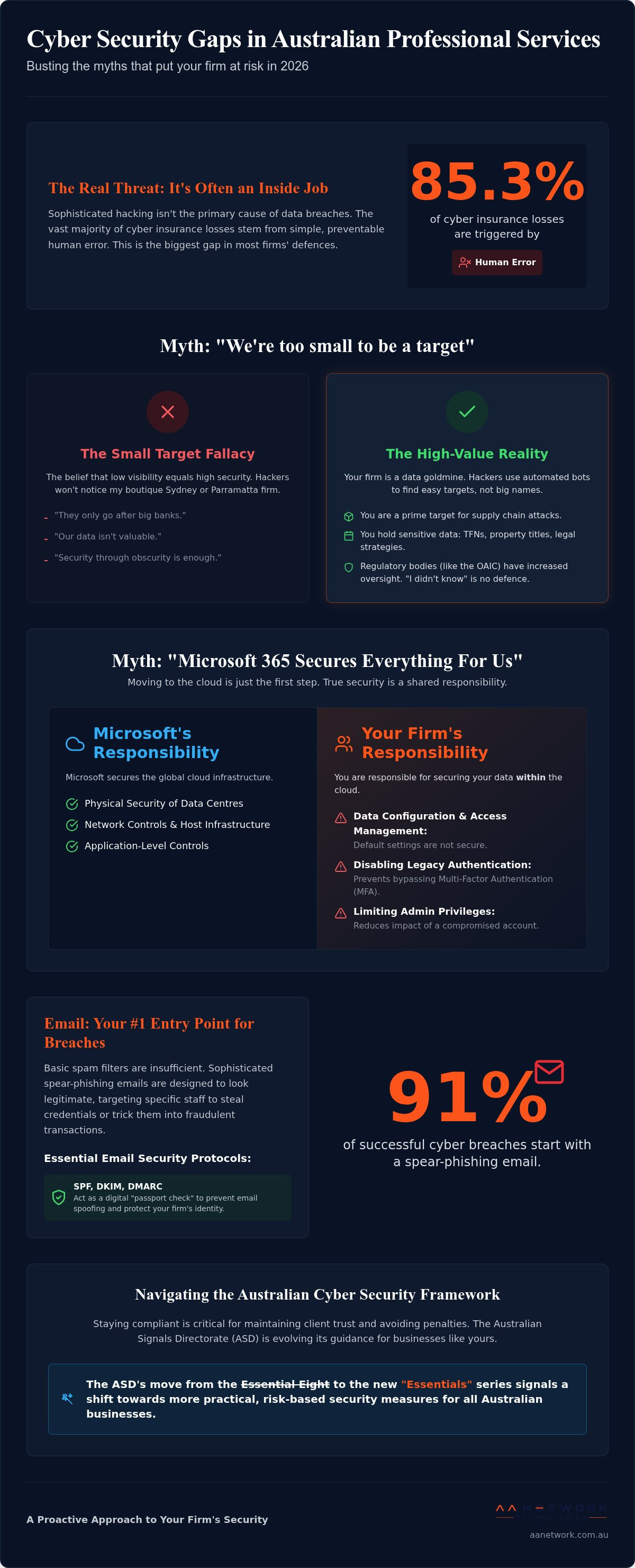
Did you know that 85.3% of cyber insurance losses in the first half of 2026 were triggered by human error rather than sophisticated hacking? For many Sydney and Parramatta firms, the most dangerous cyber security gaps in professional services aren't technical glitches; they're the subtle misunderstandings of how modern cloud environments actually work. You've likely spent years building a reputation for discretion and reliability, only to find that the digital landscape has shifted beneath your feet.
It's completely understandable to feel overwhelmed by the Australian Signals Directorate's move to replace the Essential Eight with the new "Essentials" series. You want protection that works without the eye-watering price tag of enterprise-level solutions. This guide will reveal the hidden vulnerabilities currently lurking in your practice and provide a clear path to bridge those gaps before your client data is at risk. We're going to bust five common myths about cloud security and compliance, giving you the actionable steps needed to secure your firm for 2026 and beyond.
Key Takeaways
- Realise why your firm's data makes you a primary target for hackers, regardless of your business size or location.
- Master the shared responsibility model to ensure your Microsoft 365 setup is actually protecting your reputation and client files.
- Discover how to address the cyber security gaps professional services firms encounter when technical tools and human habits clash.
- Prepare your practice for the upcoming changes to Australian cyber security frameworks to stay compliant and maintain client trust.
- Learn how a proactive, local approach to IT support can resolve daily frustrations while securing your firm's long-term future.
The Myth of the "Small Target": Why Professional Services are High-Value
Many boutique firms in Sydney CBD and Parramatta operate under a dangerous assumption. They believe that because they aren't a multinational bank or a government department, they are invisible to cybercriminals. By 2026, this "security through obscurity" has proven to be a fatal mistake. Modern hackers don't sit in dark rooms manually picking targets; they use AI-driven bots to scan the entire Australian digital landscape for vulnerabilities. They aren't looking for your brand name. They are looking for an unpatched server or a weak password.
Your firm is actually a data goldmine. Whether you're in law, accounting, or architecture, you hold sensitive information that fetches a high price on the dark web. This include tax file numbers, property titles, and confidential litigation strategies. For a criminal, your practice represents a high-reward, low-risk opportunity. The real cost of a breach isn't just the ransom demand. It is the permanent damage to your reputation. In professional services, trust is your only real currency. Once that's gone, your clients will be too.
The "Small Firm" invisibility myth
Hackers often find it more profitable to hit ten small firms with weak defences than to spend months trying to crack one high-security enterprise. This strategy is a primary reason for the widening cyber security gaps professional services firms are currently facing. You are also a prime target for supply chain attacks. If a hacker compromises your email, they can impersonate you to send fraudulent invoices to your largest, wealthiest clients. The Small Target Fallacy is the belief that low visibility equals high security. In reality, being a "small target" just means you're more likely to have a "soft" perimeter that is easy to penetrate.
Regulatory pressure in Australia
Compliance is no longer a suggestion for small business owners. By 2026, the Office of the Australian Information Commissioner (OAIC) has significantly increased its oversight of professional sectors. New regulations across New South Wales mean that "I didn't know" is no longer a valid legal defence. Many of these breaches start with Human Error and Social Engineering, where a staff member is tricked into revealing credentials. If you haven't addressed the cyber security gaps professional services firms are now expected to manage, you face heavy financial penalties and mandatory public disclosure of your failure. Protecting your data is now as much a legal obligation as paying your GST.
Busting the "Cloud Security" Bubble in Microsoft 365
Many firms in Sydney CBD and Parramatta assume that moving their files to Microsoft 365 means their security is "sorted". It's a comforting thought, but it's a dangerous misconception. Microsoft provides a secure infrastructure, but they don't manage your specific settings, your data, or who you choose to give access to. This is known as the Shared Responsibility Model. If you leave your environment on its default settings, you are essentially leaving the front door to your firm's digital assets unlocked. CISA provides detailed guidance on Busting the "Cloud Security" Bubble in Microsoft 365, highlighting that basic configurations are rarely enough to stop a determined attacker. Relying solely on Microsoft's "out of the box" protection is one of the most significant cyber security gaps professional services firms face today.
The "Default Settings" danger
Leaving M365 on default settings is a massive oversight. One of the biggest risks is legacy authentication, which allows older apps to bypass modern security checks like Multi-Factor Authentication (MFA). Hackers love these "back doors" because they're easy to find and exploit. We also frequently see "Global Admin" privileges over-assigned. If every partner and senior manager has full administrative rights, a single compromised password can give a hacker total control over your entire firm. You should only give staff the specific access they need to do their jobs, nothing more.
Email: The #1 entry point for Sydney breaches
Basic spam filters are no longer a match for the sophisticated phishing campaigns we see in 2026. Criminals now research your firm to create highly convincing emails that look exactly like a request from a trusted vendor or a colleague. In fact, 91% of successful breaches start with a spear-phishing email targeting a specific partner. To close these cyber security gaps professional services firms must implement advanced protocols like SPF, DKIM, and DMARC. These tools act as a digital "passport check" for your emails, ensuring that nobody can spoof your firm's identity to trick your clients or staff.
If you're only looking at your IT when something breaks, you're already behind. This is why your Microsoft 365 support Sydney needs to be proactive rather than reactive. By constantly monitoring and optimising your cloud environment, you can stop threats before they reach an inbox. If you aren't sure where your current setup stands, a quick check-in with a local IT partner can help you identify these vulnerabilities before they become a crisis.
The Invisible Gap: Human Error and Social Engineering
It's a common mistake to think that buying the most expensive firewall or antivirus software solves your security problems once and for all. If technology were the only answer, we wouldn't see 85.3% of cyber insurance losses in 2026 stemming from human error. The most persistent cyber security gaps professional services firms face are often found in the boardroom, not the server room. Your smartest, most experienced staff members are frequently your biggest vulnerability because they're often the busiest. When a partner is rushing between back-to-back meetings, they're far more likely to click a link that looks like a legitimate court filing or a client's urgent tax document.
We've seen a sharp rise in AI-driven deepfake phishing, particularly in the Australian legal sector. Attackers can now use AI to clone a partner's voice or face for a video call, instructing a junior clerk to make an "urgent" trust account transfer. Creating a culture of security doesn't have to eat into your billable hours. It's about building simple, repeatable habits that become second nature, much like how you'd double-check a contract before signing.
Social engineering in a professional context
Accounting firms are under immense pressure during tax season, which is exactly when "Urgent Invoice" scams peak. These attacks use psychological triggers like urgency and authority to bypass your usual checks. A staff member receives an email that appears to be from the ATO or a major vendor, demanding immediate payment to avoid "penalties". Training your team to spot Business Email Compromise (BEC) is vital. It's about teaching them to pause and verify through a different channel before acting on any request involving money or sensitive data.
The "Shadow IT" gap
When IT systems are clunky or restrictive, staff naturally look for shortcuts. This creates a "Shadow IT" gap where client files end up on personal Dropbox accounts or in WhatsApp chats for the sake of speed. While this might save five minutes, it leaves your firm completely exposed. Unmanaged devices in a "Work from Anywhere" world mean your client's confidential data could be sitting on a home iPad with no password protection. The solution isn't to ban these habits but to provide better, more efficient tools. By following The Essential Eight Framework for 2026, you can implement secure, user-friendly alternatives that keep your team productive without compromising your firm's reputation. Closing these cyber security gaps professional services firms often ignore starts with giving your people the right tools for the job.
Bridging the Gaps: The Essential Eight Framework for 2026
The Australian Signals Directorate (ASD) recently announced the retirement of the Essential Eight, transitioning it into a broader "Essentials" series. For a Sydney partner or practice manager, this shift is critical. While the names are changing, the core strategies remain the most effective way to close cyber security gaps professional services firms face in a high-threat environment. These strategies provide a baseline that moves your firm beyond simple compliance. It builds actual resilience. Effective cyber security for law firms Sydney relies on these Australian standards because they address the exact technical vulnerabilities that hackers exploit. Implementing these strategies moves your firm beyond simple box-ticking into a state of proactive readiness.
Application Whitelisting and Patching
Leaving your software unpatched is like leaving your office front door unlocked after hours. Hackers look for known vulnerabilities in common tools like PDF readers or browser extensions to gain a foothold. Application control ensures that only approved, safe programs can run on your network. This prevents malicious scripts from executing even if a staff member accidentally downloads a suspicious file. In a high-pressure professional environment, you can't rely on manual updates. Automated patching ensures your systems are always current without interrupting your daily workflows. This proactive approach is essential for bridging the cyber security gaps professional services firms often ignore until it's too late.
Multi-Factor Authentication (MFA): The non-negotiable
By 2026, SMS-based MFA is no longer considered secure. Cybercriminals have mastered "SIM swapping" and interception techniques that make text message codes easy to bypass. Your firm needs to move toward hardware security keys or dedicated authenticator apps. This single step is the most powerful tool in your arsenal. MFA can block over 99% of account takeover attacks. It's the difference between a minor login attempt and a full-scale data breach that requires mandatory notification to the Office of the Australian Information Commissioner. Relying on outdated authentication methods is a risk your reputation simply cannot afford.
If you're unsure where your firm sits on the maturity scale, it's time for a professional audit. We can help you identify your vulnerabilities with a comprehensive IT health check tailored for Sydney professionals. Our team will ensure your defences are aligned with the latest Australian standards, giving you the peace of mind to focus on your clients.
The Proactive Guardian: Closing Gaps with AA Network Technologies
At AA Network Technologies, we believe your IT partner should be a person you know, not a ticket number in a queue. Most corporate technology providers operate from distant call centres, offering generic advice that rarely accounts for the specific pressures of a high-stakes Sydney practice. We take a different approach. We act as your proactive guardian, identifying and closing cyber security gaps professional services firms often overlook until a crisis hits. Our managed IT support Sydney is designed to give you back your time. We handle the technical heavy lifting so you can focus on billable hours and client results.
We pride ourselves on being straight-talkers. You won't hear us hiding behind impenetrable technical jargon or trying to upsell you on enterprise solutions you don't actually need. Instead, we provide clear, pragmatic strategies that work for your specific business size and budget. Whether it's securing your Microsoft 365 environment or training your staff to spot a deepfake, we provide the human-to-human connection that faceless competitors simply cannot match. It's about removing daily frustrations and replacing them with reliable, accountable partnership.
Local expertise for Sydney and Parramatta
When your system goes down or you suspect a breach, you don't want to wait 24 hours for a remote technician to look into it. You need someone who can be on-site in an hour. Being based locally in Sydney CBD and Parramatta allows AA Network Technologies to provide high-touch support that is physically present when it matters most. We have deep experience in cyber security for accounting firms Sydney, understanding the seasonal pressures and strict confidentiality requirements of the sector. This isn't just about fixing computers; it's about building a long-term partnership based on transparency and mutual trust.
Your next steps to a secure firm
Taking the first step toward a more secure firm shouldn't feel like a burden. We offer a free 30-minute IT health check specifically for professional firms in the Sydney region. This isn't a sales pitch. It's a high-level security gap analysis where we look at your current defences, your cloud configuration, and your backup systems. We'll give you a clear picture of where your cyber security gaps professional services vulnerabilities lie and provide actionable steps to bridge them. By taking this technical weight off your shoulders, we help you regain the peace of mind that comes from knowing your client data is protected by a watchful, local ally.
Protecting Your Practice and Your Reputation
Your firm's reputation is built on years of trust and discretion. Don't let one misconfigured cloud setting or a deceptive email put that hard work at risk. We've seen that closing cyber security gaps professional services firms struggle with requires more than just software. It takes a shift toward proactive resilience; ensuring your staff are trained and your systems are aligned with the latest Australian standards. Whether you're based in the Sydney CBD or Parramatta, you deserve a technology partner who understands the high stakes of your industry.
As a founder-led team, we provide the personal, on-site support that faceless corporate providers can't match. We're here to take the technical burden off your shoulders so you can focus on your clients. Take the first step toward a more secure practice by identifying your vulnerabilities before they become a crisis. Book your free 30-minute IT health check with our Sydney experts today. You'll get straight talk and actionable advice to help you sleep better at night. Let's work together to keep your firm safe and your clients protected.
Frequently Asked Questions
What are the most common cyber security gaps in professional services today?
The most frequent cyber security gaps professional services firms face are misconfigured Microsoft 365 settings and a lack of formal staff training. Many firms leave their cloud environment on default settings, which creates easy entry points for hackers. We also see many practices running outdated software that hasn't been patched. These gaps aren't just technical; they're often simple oversights that leave your client data exposed to automated scans.
Does my Sydney firm really need to follow the Essential Eight framework?
Yes, following the Essential Eight is the best way to protect your reputation in Australia. While the ASD is transitioning to a broader "Essentials" series in 2026, the core principles remain the gold standard for local firms. Implementing these strategies shows your clients that you take their confidentiality seriously. It moves your firm from a state of basic compliance to genuine digital resilience.
Is Microsoft 365 secure enough for a law firm without extra protection?
Microsoft 365 is a secure platform, but it isn't fully protected "out of the box". Under the Shared Responsibility Model, Microsoft secures the infrastructure while you're responsible for configuring the security settings. Law firms handle highly sensitive data and often require advanced email filtering and strict access controls that aren't enabled by default. You must actively manage these settings to ensure your client files stay private.
How much does it cost to fix cyber security gaps in a small firm?
The investment required depends entirely on your firm's current maturity level and the complexity of your data. We don't believe in one-size-fits-all pricing because a five-person accounting firm has different needs than a large legal practice. Addressing the cyber security gaps professional services firms encounter is generally far more affordable than the legal fees and mandatory disclosure costs that follow a successful data breach.
What is the difference between a cyber security audit and a health check?
A cyber security audit is a deep, formal investigation often used for regulatory compliance or insurance purposes. It involves detailed documentation and testing of every protocol. A health check is a more practical, high-level review designed to find immediate risks. Our 30-minute health check focuses on identifying the most dangerous vulnerabilities in your current setup so you can fix them before they're exploited.
Can human error really be prevented with cyber security training?
You can't eliminate human error entirely, but you can significantly reduce the risk. Since over 85% of cyber losses in 2026 involve human mistakes, training your staff to spot deepfakes and phishing attempts is your best defence. It's about building a culture where your team feels comfortable double-checking an "urgent" request. This simple habit can stop a breach before it even starts.
What should I do if I think my professional service firm has been breached?
If you suspect a breach, you should immediately disconnect the affected devices from the internet but do not turn them off or delete any files. Contact your IT partner straight away to begin a forensic investigation. You may also have a legal obligation to notify the Office of the Australian Information Commissioner (OAIC) under the Notifiable Data Breaches scheme. Acting quickly is the best way to limit the damage.
Why should I choose a local Sydney IT provider over a global one?
A local provider offers accountability and a neighborly approach that global call centres simply can't match. We understand the specific regulatory landscape in New South Wales and can be on-site in the CBD or Parramatta within an hour if a crisis occurs. You get a partner who knows your business and takes a personal interest in your success, rather than just a faceless ticket number.
