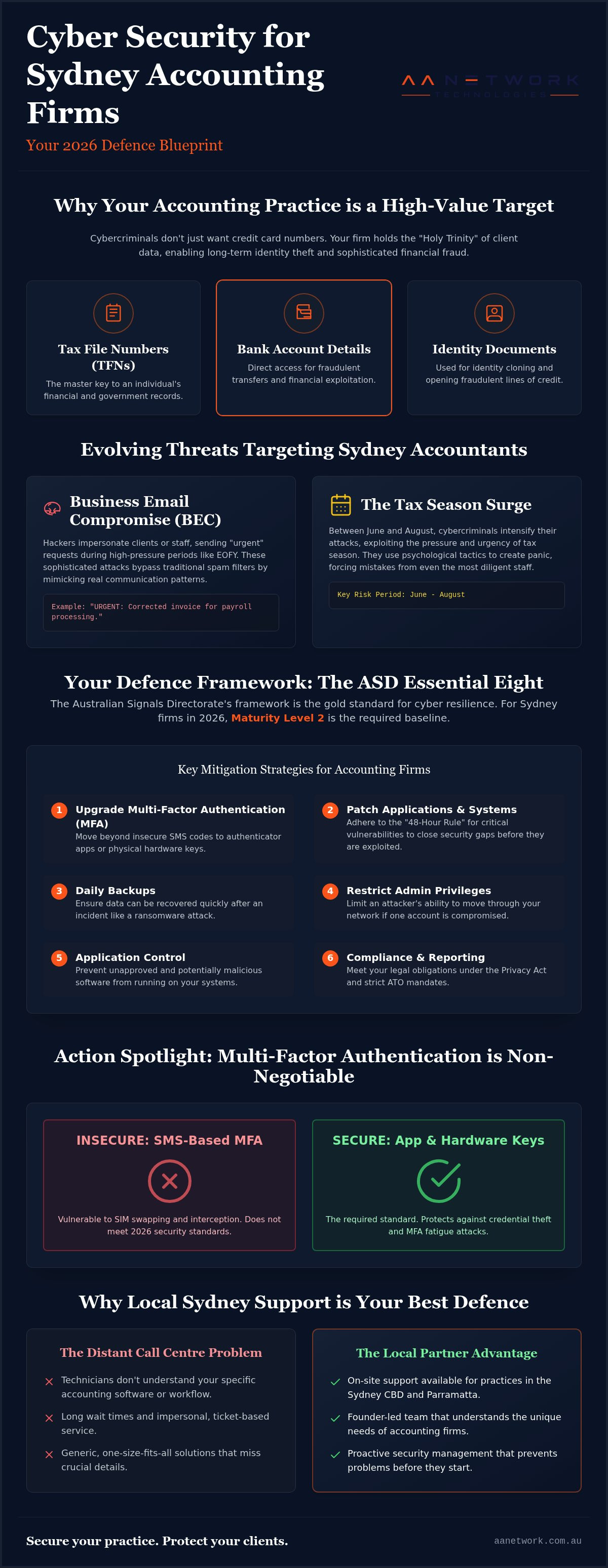

Cyber Security for Accounting Firms Sydney: The 2026 Essential Checklist
What if your firm's entire client database vanished or was locked behind a ransom demand right at the peak of the June tax rush? For many practice owners, this isn't just a bad dream; it's a growing reality as cyber threats evolve. Managing cyber security for accounting firms Sydney has become more than just installing an antivirus; it's about protecting your reputation and staying on the right side of the ATO. You've likely felt the frustration of trying to decode the Essential Eight requirements or waiting on hold for a call centre technician who doesn't understand your specific software workflow.
We agree that your focus should be on your clients, not worrying about data breaches or complex technical jargon. This guide provides a clear, actionable checklist designed specifically for the Sydney accounting landscape in 2026. You'll gain a straightforward path to securing your practice, meeting Australian privacy laws, and understanding how a local partner in the CBD or Parramatta can provide the on-site support you need to stay compliant. We'll break down the technical requirements into plain English so you can get back to your primary work with total peace of mind.
Key Takeaways
- Identify why your practice's TFN and bank data make you a high-value target and how to safeguard the "Holy Trinity" of client information.
- Navigate the ASD Essential Eight framework to reach Maturity Level 2, the current benchmark for cyber security for accounting firms Sydney.
- Implement a practical daily and weekly checklist that keeps your firm compliant with Australian privacy laws and ATO standards.
- Prepare for the "Tax Season Surge" by learning to recognise sophisticated scams that target Sydney accountants between June and August.
- Understand the benefits of a local, founder-led IT partner who provides on-site support in the CBD or Parramatta instead of a distant call centre.
Why Sydney Accounting Firms are High-Value Targets in 2026
Accounting firms in the Sydney CBD and Parramatta aren't just managing ledgers; they're guarding the "Holy Trinity" of sensitive data. This includes Tax File Numbers (TFNs), bank account details, and government-issued identity documents. To a cybercriminal, this information is far more valuable than a simple credit card number because it allows for long-term identity takeover and sophisticated financial fraud. Because you hold all three, your practice is a permanent fixture on hacker hit lists.
The geographical concentration of wealth in our city makes local practices a primary target. With the highest concentration of high-net-worth individuals in Australia, Sydney accounting firms represent a lucrative entry point for sophisticated BEC scams. Beyond the office towers, the shift to hybrid work has stretched the attack surface. Your security perimeter no longer stops at the office door; it now extends to home offices in the Inner West, the North Shore, and the Hills District. This decentralised setup makes cyber security for accounting firms Sydney more complex than ever before.
The Evolving Threat of Business Email Compromise (BEC)
BEC isn't just about generic spam. It's about a criminal sitting in your inbox, learning your speech patterns, and waiting for the right moment to strike. During the high-pressure June and July tax season, hackers use psychological tactics to induce panic and force mistakes. They might send a "corrected" invoice or an "urgent" payroll update that looks identical to a local client's request. Traditional spam filters often miss these personalised attempts because they lack the technical red flags of older, mass-mailed scams. This makes robust cyber security for accounting firms Sydney a non-negotiable requirement for staying operational during the EOFY rush.
Regulatory Pressure: The ATO and Privacy Act 1988
Compliance is no longer a "nice to have" feature. Under the Privacy Act 1988 and the Notifiable Data Breaches (NDB) scheme, you have a legal obligation to report any incident that could result in serious harm. In 2026, the ATO has tightened security requirements for registered tax agents, moving from general suggestions to strict technical mandates. Beyond the potential for heavy fines, consider the reputational cost. Sydney's professional community is tight-knit and built on trust. A data breach isn't just a technical failure; it's a public signal that your firm didn't prioritise client safety, which can be impossible to recover from in a competitive market.
The Essential Eight: A Framework for Sydney Practices
The Australian Signals Directorate (ASD) developed the Essential Eight to give organisations a clear, prioritised list of mitigation strategies. For any professional service provider, these eight steps are the gold standard for building cyber resilience. In 2026, local firms must aim for Maturity Level 2 as a baseline. This level is designed to protect against adversaries who are more determined and use increasingly sophisticated tools to bypass basic defences. Implementing these strategies ensures that cyber security for accounting firms Sydney is robust enough to handle modern threats without slowing down your daily operations.
At its core, the framework focuses on three primary goals: preventing attacks, limiting the impact of an incident, and ensuring data can be recovered. This involves technical controls like application control, which prevents unapproved software from executing on your network. It also means restricting administrative privileges so that if one account is compromised, the hacker can't move laterally through your entire system. AA Network Technologies simplifies these enterprise-grade strategies, making them accessible for mid-sized practices that don't have a dedicated in-house IT department.
Multi-Factor Authentication (MFA) is Non-Negotiable
Relying on SMS-based MFA is a risk you can't afford to take in 2026. Hackers have become adept at SIM swapping and intercepting text codes. To stay secure, your firm should move to authenticator apps or physical hardware keys across Microsoft 365 and platforms like Xero or MYOB. We also focus on training your team to recognise "MFA fatigue" attacks. This occurs when a staff member is bombarded with login prompts until they accidentally hit "approve" out of sheer frustration. A quick 30-minute IT health check can help identify which of your current systems are still vulnerable to these credential-based attacks.
Patching and Backup: Your Last Line of Defence
The "48-hour rule" is the new benchmark for patching critical vulnerabilities. When a software flaw is discovered, criminals often begin exploiting it within hours. If your systems aren't updated almost immediately, you're leaving the door wide open. Alongside rapid patching, your firm needs immutable off-site backups. Immutable means the data cannot be changed, encrypted, or deleted, even if a hacker gains administrative access to your network. This is the only way to survive a ransomware attack without paying a cent to criminals. We help you test your business continuity plan regularly to ensure you can recover your data in hours, not days, keeping your Sydney practice operational when it matters most.
Sydney-Specific Threats: Protecting Your Practice During Tax Season
The months between June and August are the busiest time for your practice, but they're also the most dangerous. Cybercriminals know your team is under pressure, working long hours, and more likely to overlook a suspicious link. This period, often called the "Tax Season Surge", sees a significant spike in activity. Localised phishing is a major part of this threat. Scams often perfectly mimic communications from the ATO or major Sydney-based banks, luring staff into providing credentials or downloading malicious attachments while they're rushing to meet filing deadlines.
Hiring temporary staff to handle the peak workload introduces another layer of risk known as "shadow IT". When seasonal workers use their own unapproved apps, personal Dropbox accounts, or even WhatsApp to move files, your data security vanishes. You lose the ability to track where sensitive information is going. It's vital to move away from sending sensitive documents via unencrypted email. Using a dedicated, secure client portal ensures that TFNs and financial statements remain protected, keeping your cyber security for accounting firms Sydney intact even when the office is at its most chaotic.
The Risk of the "Work From Anywhere" Sydney Lifestyle
Sydney accountants love the flexibility of our city, whether it's checking emails from a home office in the Eastern Suburbs or finishing a report while commuting from the Northern Beaches. However, home Wi-Fi and public hotspots at CBD cafes or transit hubs like Wynyard or Town Hall are rarely secure. Without a robust VPN and endpoint protection on every laptop and phone, your mobile devices are vulnerable to interception. We help you treat every connection outside the office as a potential risk that requires enterprise-grade encryption to keep client data private.
Vetting Your Software Suppliers
When choosing a CRM or document management system, you must ask about data residency. Is your clients' sensitive information actually stored on servers within Australia? Local data residency isn't just about compliance with the Privacy Act; it also provides better speed and lower latency for your Sydney team. Ensure your software providers meet Australian security standards before you trust them with your database. Selecting partners who prioritise local infrastructure is a key component of a modern strategy for cyber security for accounting firms Sydney.
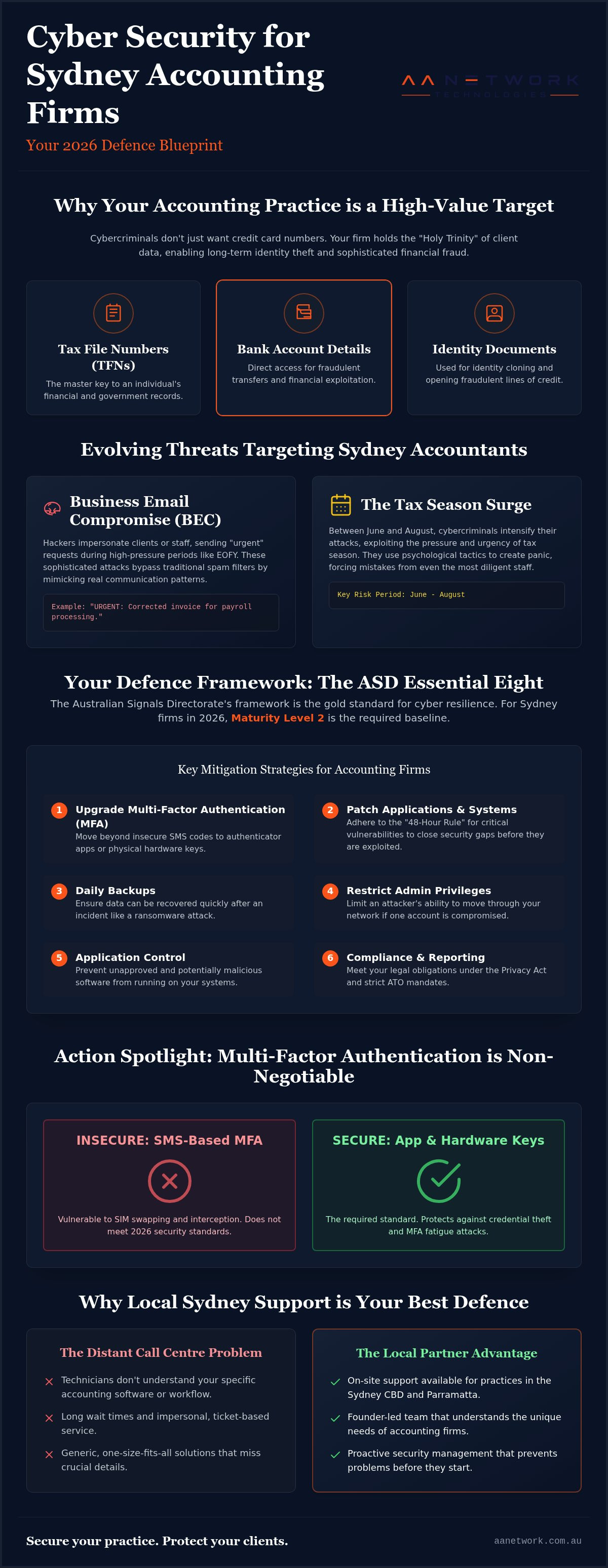
The Ultimate 2026 Accounting Cyber Security Checklist
Moving from theory to practice requires a consistent rhythm. Cyber security for accounting firms Sydney isn't a one-off project you can set and forget; it's a series of ongoing habits that protect your reputation. By breaking these tasks into a manageable cadence, you ensure that security becomes part of your firm's DNA rather than an administrative burden. This structured approach helps you stay ahead of sophisticated threats while maintaining your focus on client billables.
- Daily: Review your security logs and confirm that endpoint protection is active on every device, including those used by staff working from home.
- Weekly: Verify that all critical patches have been successfully applied across your network to meet the 48-hour benchmark for known vulnerabilities.
- Monthly: Conduct a "Lunch and Learn" session. Keeping staff alert to the latest AI-driven scam trends is your best defence against human error.
- Quarterly: Perform a full backup restoration test. Simply having a backup isn't enough; you must prove you can actually recover your data quickly. Update your incident response plan to reflect any changes in your team or software stack.
- Annually: Book a professional IT health check to identify hidden gaps in your perimeter and ensure you still meet the latest ATO requirements.
Administrative and People Controls
Your team is your strongest asset, but they can also be your biggest vulnerability. We recommend implementing the Principle of Least Privilege. This means junior staff and contractors only have access to the specific files they need for their current tasks; they don't need broad administrative rights. Formalised onboarding and offboarding procedures are equally vital. When a staff member leaves your firm, their access to your Microsoft 365 environment and client portals must be revoked immediately. A clear Acceptable Use Policy ensures everyone knows the rules for using firm-owned devices, whether they're in the CBD office or a cafe in Parramatta.
Technical Infrastructure Controls
Hardening your technical environment starts with simple but effective changes. Disabling macro execution in Microsoft Office remains one of the most effective ways to block common malware entry points. Don't rely on default settings for your Microsoft 365 environment; it requires specialised optimisation to be truly secure. In 2026, we also recommend AI-driven email security. These tools can detect subtle tone-of-voice changes in emails, flagging potential BEC attempts that traditional filters might miss. If you haven't reviewed your current defences recently, it's time to book an assessment to see how these modern tools can protect your practice.
Beyond the Software: Why Local Sydney Support is Your Best Defence
Deploying the right software is a critical step, but technology alone can't protect your firm from every variable. When a security incident occurs or a critical system fails, you don't want to be stuck in the "Call Centre Trap". Waiting on hold for a remote technician who is based in a different time zone is a genuine security risk during a crisis. In those high-pressure moments, every minute of delay increases the potential for data loss or financial damage. You need a partner who can step away from the screen and actually walk into your office.
Founder-led accountability changes the dynamic of your IT relationship. Dealing with a fellow Sydney business owner means you're working with someone who understands the stakes of your reputation and the importance of ATO compliance. AA Network Technologies acts as a proactive guardian for your practice, taking on the burden of technical management so you can stay focused on your clients. Our team provides the human connection that automated services lack, offering hands-on support that builds a culture of security within your firm.
Reducing Downtime in the CBD and Parramatta
Our local proximity to the Sydney CBD and Parramatta allows for a rapid response that remote-only providers simply can't match. We understand the local Sydney infrastructure and the specific telco landscape that powers our city's professional hubs. Whether it's a physical hardware failure or a complex network issue, being nearby means we can resolve problems quickly to protect your billable time. For firms looking for more than just security, our broader Managed IT Support Sydney ensures your entire digital environment remains stable and efficient.
Your First Step: The 30-Minute IT Health Check
Effective cyber security for accounting firms Sydney starts with knowing exactly where you stand. Our free, no-obligation security assessment is designed to be a transparent briefing, not a sales pitch. During this 30-minute check, we identify the "Low Hanging Fruit"-those simple, often overlooked vulnerabilities that could save your practice from a devastating breach. We'll look at your current MFA setup, backup protocols, and patch management to give you a clear picture of your resilience. Don't wait for a crisis to discover the gaps in your defence. Book your free 30-minute IT Health Check with AA Network today.
Protect Your Practice and Your Reputation in 2026
Securing your firm isn't just about ticking boxes for the ATO; it's about the promise you make to your clients to keep their most sensitive data safe. We've seen how the combination of the Essential Eight framework and a disciplined daily checklist can transform a vulnerable office into a resilient practice. By moving away from faceless call centres and choosing a local, founder-led partner, you gain the accountability and on-site support your Sydney CBD or Parramatta office deserves. You don't have to manage these technical burdens alone while trying to meet tax deadlines.
The first step to robust cyber security for accounting firms Sydney is understanding where your current defences might be failing. We specialise in professional service compliance and offer hands-on help that actually makes sense for your workflow. It's time to swap the fear of a data breach for the peace of mind that comes from a reliable partnership. Secure your practice with a free 30-minute IT Health Check today and ensure your firm is ready for the challenges of the coming year. We're here to help you stay focused on what you do best.
Frequently Asked Questions
Is cyber security insurance enough to protect my Sydney accounting firm?
Cyber insurance is a vital safety net, but it is not a substitute for active technical defences. While a policy can help cover the financial costs of data recovery and legal fees, it won't prevent a breach from happening or repair a damaged reputation. Effective cyber security for accounting firms Sydney requires proactive measures like the Essential Eight to stop criminals before they access your clients' sensitive TFNs and bank details.
What are the ATO’s minimum cyber security requirements for tax agents in 2026?
The ATO requires registered tax agents to implement multi-factor authentication (MFA) for all systems containing client information, including cloud accounting software and remote access tools. You must also ensure that sensitive data is encrypted and that your firm complies with the Privacy Act 1988. In 2026, there is an increased focus on verifying that your third-party software providers maintain high security standards and Australian data residency.
How often should we train our staff on cyber security awareness?
Staff training should be an ongoing process rather than a once-a-year event. We recommend short, monthly "Lunch and Learn" sessions to keep your team updated on the latest scam trends, such as AI-driven phishing. Cyber threats evolve too quickly for annual training to be effective; regular reminders help your staff stay vigilant during the high-pressure tax season when they are most likely to be targeted.
Does a small practice really need to follow the ASD Essential Eight?
Yes, every practice holding sensitive financial data should use the Essential Eight as their security baseline. Criminals often target smaller firms specifically because they assume the defences will be less sophisticated than those at larger CBD organisations. Following this framework ensures you have a proven, Australian-standard defence that protects your practice from the most common cyber threats.
What is the most common cyber attack targeting Sydney accountants right now?
Business Email Compromise (BEC) is currently the most frequent threat facing the local accounting sector. These attacks involve hackers gaining access to an email account to impersonate a staff member or client, often with the goal of redirecting invoice payments to a fraudulent bank account. Because these emails are highly personalised and don't always contain malicious links, they are specifically designed to bypass traditional spam filters.
How much does professional cyber security management cost for a mid-sized firm?
The investment for professional management depends on the number of users in your practice and the complexity of your current IT infrastructure. Rather than a flat fee, we focus on providing a tailored service that balances robust protection with your firm's specific operational needs. Investing in professional management is significantly more cost-effective than the potential hundreds of thousands of dollars lost during a major data breach or ransomware event.
What should I do if I suspect my firm has been hit by a data breach?
Disconnect any affected devices from the internet immediately and contact your IT support partner to begin your incident response plan. Do not attempt to delete files or change system settings yourself, as this can destroy evidence needed to understand how the breach occurred. You must also assess whether the incident falls under the Notifiable Data Breaches (NDB) scheme, which requires you to notify the Australian Information Commissioner and affected clients.
Can AA Network help us migrate to a secure cloud environment like Azure?
Yes, we specialise in secure cloud migration and Microsoft 365 optimisation for professional services. We handle the entire transition to ensure your data is moved safely and that your new environment is hardened against modern threats. Our local Sydney team provides on-site support throughout the migration process, ensuring your staff can work securely from the CBD office or their home in the suburbs.