

Business Cyber Security: 2026 Guide for Sydney Firms
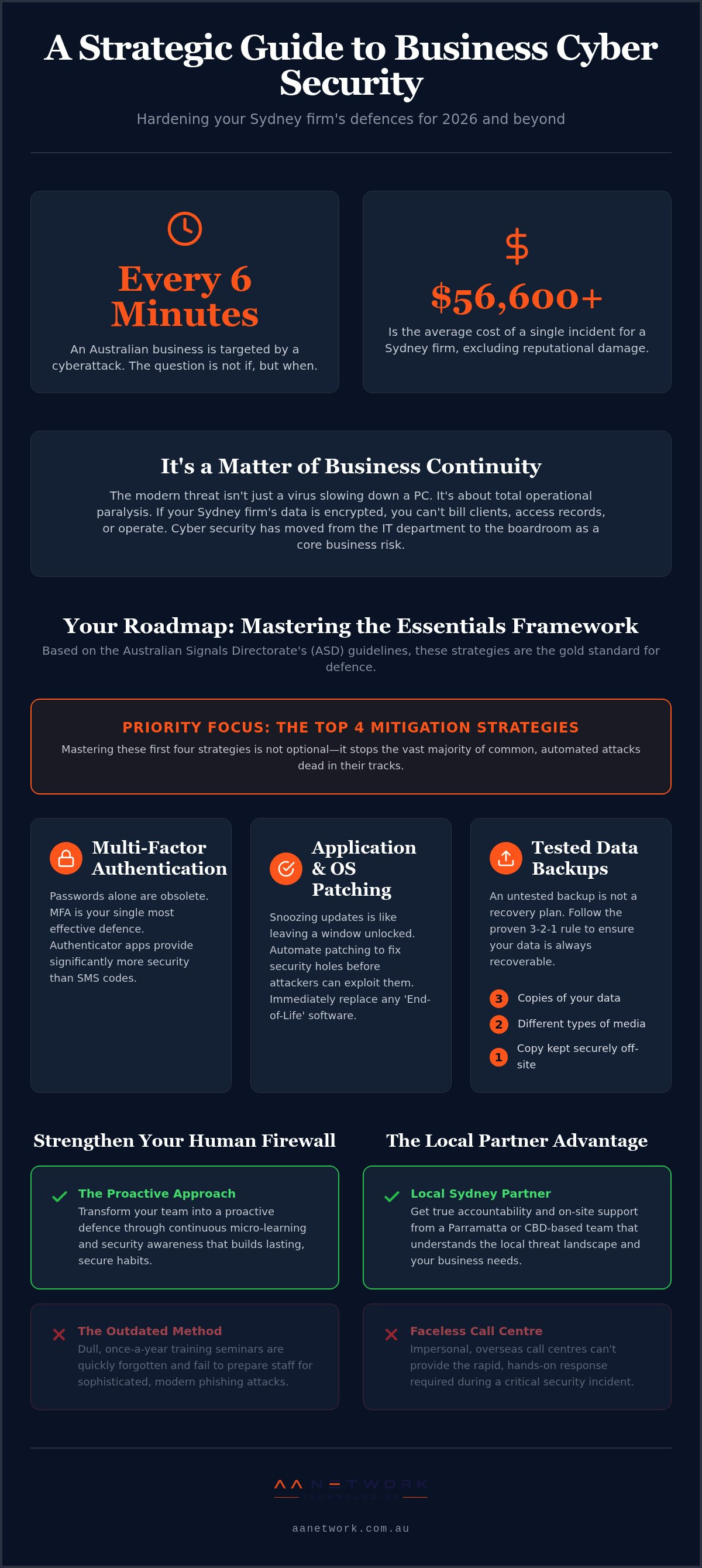
With a cyberattack now hitting an Australian business every six minutes, the question isn't whether you'll be targeted, but if your systems can withstand the pressure. For many Sydney firms, the average cost of a single incident has climbed past $56,600, a figure that doesn't even account for the long-term reputational damage of a client data leak. You're likely wondering how to improve business cyber security without getting buried in technical jargon or blowing your budget on tools you don't understand.
We know how frustrating it is to hear "solutions" that sound like a foreign language while you're just trying to keep your Parramatta or CBD office running smoothly. You want peace of mind that your data is locked down and your firm is compliant with the latest Australian standards. This guide provides a clear, practical roadmap to harden your defences for 2026. We'll break down the transition from the retired Essential Eight to the new Essentials series and show you exactly how to protect your team and your clients with confidence.
Key Takeaways
- Shift your perspective from simple virus protection to business continuity to ensure your Sydney firm stays operational during a crisis.
- Master the transition from the ASD Essential Eight to the new Essentials series to build a robust security baseline for 2026.
- Discover how to improve business cyber security by balancing simple daily habits with professional managed protection tailored to your industry.
- Learn how to transform your team into a proactive human firewall through continuous micro-learning rather than dull annual seminars.
- Find out why a local partner like AA Network Technologies in Sydney or Parramatta provides the accountability and on-site support a faceless call centre can't match.
Why Cyber Security is Now a Boardroom Issue for Sydney Small Businesses
Cyber security is no longer just about stopping a virus from slowing down your laptop. It is about business continuity. If your Sydney firm cannot access its files, you cannot bill your clients. It is that simple. Many partners and directors still believe they are too small to be a target, often called the "Small Business Myth." In reality, hackers see Sydney SMBs as low-hanging fruit. They know smaller practices often have weaker defences than the big banks, making them the perfect entry point for data theft. Understanding the foundational principles of computer security helps you see that protection is a continuous habit, not a one-time software purchase.
A breach is incredibly expensive. While a ransom demand is scary, the true damage lies in the loss of billable hours. With the average cost of a single cyber incident for Australian SMEs now exceeding $56,600, the financial sting is real. If your team is sitting idle in a Parramatta office because your systems are encrypted, your overheads keep running while your revenue hits zero. This is why learning how to improve business cyber security has moved from the IT basement to the boardroom table. It is a fundamental risk management task that determines whether your business survives a crisis.
The Local Threat Landscape in Sydney
Sydney CBD professional services are currently facing a surge in highly targeted spear-phishing. These aren't the obvious, poorly written scams of the past. They are sophisticated messages tailored to look like they are from the Law Society, a known supplier, or even a colleague. A "set and forget" approach to IT support is a major vulnerability in this environment. If your current provider is not actively monitoring your network for unusual activity, you are essentially leaving your front door unlocked in a busy city centre.
Compliance and Your Duty of Care
For those in the legal sector, staying aligned with the cyber security for law firms Sydney guidelines is now a baseline requirement for professional indemnity. Accounting firms face similar pressure from the ATO, which has strict expectations for any practice handling Tax File Numbers and sensitive financial data. Under Australia's mandatory breach reporting laws, a data leak is not a private headache. It is a public disclosure that can destroy decades of client trust in a single afternoon. Protecting your data is no longer just a technical choice; it is a legal and ethical duty of care to your clients.
The Essential Eight: A Step-by-Step Security Framework for Aussie SMBs
The Australian Signals Directorate (ASD) developed the Essential Eight as a baseline for all local organisations. Even as it begins transitioning to the new "Essentials series" in late 2026, these strategies remain the gold standard for how to improve business cyber security. For a five-person law firm in Parramatta, this involves simple, automated tools. For a 50-person accounting firm in the CBD, it requires stricter policy management. Prioritising the "Big Four"-MFA, patching, backups, and restricting administrative privileges-stops the vast majority of common attacks. Learning how to improve business cyber security starts with reaching "Maturity Level 2," which is now the recommended baseline for all Australian sectors.
Step 1: Implementing Multi-Factor Authentication (MFA)
Passwords are no longer enough. Hackers can bypass them in seconds using automated tools. Implementing MFA is your most effective line of defence. While SMS codes are better than nothing, authenticator apps are far more secure. When we provide Microsoft 365 support Sydney firms trust, we often set up conditional access. This ensures only authorised devices in known locations can log in, effectively locking out foreign attackers.
Step 2: Patching Applications and Operating Systems
Snoozing an update is like leaving a window unlatched. Patching fixes the "holes" hackers use to enter your network. Automating this process ensures your office laptops stay current without interrupting billable hours. You must also identify "End-of-Life" software. If the developer has stopped supporting a programme, it becomes a permanent open door for trouble. Regular updates are a simple habit that prevents complex disasters.
Step 3: Regular Backups and Recovery Testing
A backup you haven't tested is just a file taking up space. Follow the 3-2-1 rule: three copies of your data, on two different media types, with one copy kept off-site. Modern ransomware often targets your backups first to force a payment. Air-gapped or immutable cloud backups are essential to ensure you can actually recover. You can find more practical Australian government cyber security advice to help structure your recovery plan. If you aren't sure where your current setup stands, a 30-minute IT health check can identify the gaps before they become crises.
DIY Security vs. Managed Protection: Finding the Right Balance
Many Sydney business owners start by following the ACSC Small Business Cyber Security Guide to handle the basics. This is a solid first step for basic hygiene. However, professional service firms often hit a wall when their digital environment grows. Managing a complex cloud setup while trying to meet billable targets is a recipe for burnout or a missed vulnerability. When you consider that the average cost of a breach for an Aussie SME is now $56,600, the "savings" of a DIY approach quickly disappear. Real protection means moving from basic tools to active guarding.
The shift from basic hygiene to Managed Detection and Response (MDR) is where your peace of mind truly begins. A subscription to a local managed IT support Sydney partner provides a predictable monthly cost. This is a small price to pay compared to the total loss of operations. A partner doesn't just install software; they act as a proactive guardian. They watch your network for the strange patterns that software alone might miss. This allows you to focus on your clients while someone else carries the technical burden.
The Hidden Risks of the DIY Approach
The biggest danger in a DIY setup is the "silent" threat. Modern hackers in 2026 don't always announce their presence with a loud ransom note. They often sit quietly in your system for weeks, harvesting data or monitoring emails. Without professional monitoring, you won't know they are there until the damage is done. Most DIY setups also lack a formal Incident Response Plan. If you discover a breach at 4:00 pm on a Friday, knowing exactly who to call and what to unplug is the difference between a minor hiccup and a total firm shutdown.
What to Look for in a Sydney Cyber Security Partner
You need a partner who understands the specific pressures of your industry. If you run an accounting firm, you should look for a provider with a clear cyber security for accounting firms Sydney strategy. They should offer on-site support in areas like the CBD or Parramatta rather than routing you through an overseas call centre. A local partner provides a level of accountability that a faceless corporation cannot match. They should provide transparent reporting in plain English, explaining exactly what they found and how they fixed it without hiding behind technical jargon. This human connection is what makes a partnership work.
Strengthening Your Human Defence: Building a Cyber-Safe Office Culture
Even the most expensive firewall cannot stop a staff member from handing over their password to a convincing fake login page. This is why building a cyber-safe office culture is just as critical as your technical setup. When considering how to improve business cyber security, many firms make the mistake of relying on a single annual training seminar. These are usually forgotten by the following Monday. Instead, opt for continuous micro-learning. Short, two-minute videos or weekly security tips keep protection at the front of your team's mind without disrupting their billable work.
A "No-Blame" culture is your secret weapon. If an employee clicks a suspicious link, they need to feel safe reporting it instantly. Every minute they spend hiding their mistake is a minute a hacker spends moving through your network. Encourage your team to be "human firewalls" and praise them for flagging suspicious emails, even if they turn out to be legitimate. Running regular phishing simulations is another practical way to sharpen their instincts. These drills provide a safe environment for staff to learn from mistakes before a real attacker arrives. This proactive approach is a core part of how to improve business cyber security in a way that sticks.
Identifying the Red Flags of Business Email Compromise (BEC)
Hackers often use Business Email Compromise (BEC) to impersonate directors or senior partners. They study your firm's social media and website to make their emails look authentic. Their primary weapon is the "Urgency" tactic. They might send a fake invoice on a Friday afternoon, claiming it must be paid immediately to avoid a service cut-off. Never trust an email that asks for a sudden change in banking details. Establish a firm-wide protocol: any change to payment info must be verified with a quick phone call using a known number. A two-minute conversation can save your firm thousands of dollars.
Safe Remote Work Habits for Sydney Teams
Many Sydney professionals enjoy working from cafes in the CBD or Parramatta, but public "Free Wi-Fi" is a major security hole. These networks are often unencrypted, allowing hackers to "eavesdrop" on your data. If your team works remotely, ensure they use a business-grade VPN to create a secure tunnel for their traffic. Home Wi-Fi routers should also be secured with strong, unique passwords. Finally, if you allow personal devices for work (BYOD), you must have clear policies on how company data is stored and accessed. If you want to see how your team's habits currently stack up, you can book a 30-minute IT health check to identify any hidden risks in your remote setup.
Securing Your Future: Why a Local Sydney Partner Makes the Difference
Choosing a partner to manage your digital defences is a decision that impacts every part of your firm. While large corporate technology providers offer generic packages and overseas call centres, they often lack the personal investment required to truly protect a professional practice. AA Network Technologies operates differently. We provide founder-led, on-site support across the Sydney CBD and Parramatta. This means you have a direct line to a specialist who understands the local market and takes personal ownership of your success. When you are looking for how to improve business cyber security, accountability is just as important as the technology itself.
We specialise in supporting law and accounting firms because we understand your specific pressures. You don't need a technician who just fixes computers. You need a proactive guardian who ensures your firm remains compliant with Australian privacy standards while you focus on your clients. Our hands-on approach means we are often in your office, seeing how your team works and identifying risks before they turn into downtime. This local presence creates a level of trust that a faceless, automated service simply cannot match. You aren't just a ticket number in a system; you're a local business partner.
Personalised Security Roadmaps
A one-size-fits-all security package usually leaves gaps in your protection or wastes money on tools you don't need. We work with you to build a personalised roadmap that aligns your IT budget with your most critical business risks. This involves a steady, logical progression from basic hygiene to advanced monitoring. As your Sydney firm grows, your security posture must evolve with it. AA Network Technologies ensures your defences are always a step ahead of 2026 threat levels, providing ongoing monitoring that feels like a quiet, watchful ally in the background of your daily operations. We focus on outcomes like reduced downtime and verified compliance rather than just selling you more software.
Get Started with a Local Expert
The best way to understand how to improve business cyber security for your specific office is to see where you stand right now. Our 30-minute IT health check is designed to be low-friction and jargon-free. We look at your current setup to identify low-hanging fruit. These are the simple, high-impact changes that can immediately harden your defences without requiring a massive overhaul. It isn't a high-pressure sales pitch. It is a professional briefing on your current risks and the practical steps you can take to resolve them. You'll walk away with a clear understanding of your vulnerabilities and a plan to fix them.
Ready to secure your practice? Book your free 30-minute IT health check with AA Network Technologies today.
Secure Your Practice for the Year Ahead
Protecting your firm in 2026 isn't about buying the most expensive software. It's about building a culture of resilience and staying ahead of local threats in the CBD and Parramatta. You've seen that the transition from the Essential Eight to the new Essentials series is manageable when you break it down into practical steps. By focusing on the "Big Four" and training your team to spot red flags, you've already mastered the basics of how to improve business cyber security without the technical headaches.
You don't have to carry this burden alone. As a founder-led team specialising in law and accounting firms, we provide the on-site support and transparent accountability that faceless call centres can't offer. We act as your proactive guardian, ensuring your data is safe and your practice remains compliant while you focus on your billable work. We believe that reliable IT support should feel like a promise from one business owner to another.
Take the first step toward total peace of mind today. Book your free 30-minute IT health check with our Sydney experts and get a clear, jargon-free picture of your security status. Your firm's future is worth the conversation.
Frequently Asked Questions
Is my small Sydney business really a target for hackers?
Yes, you are a target because hackers view Sydney SMBs as easier entry points than large, well-defended corporations. They often use smaller firms to harvest data or gain access to larger supply chains. With an attack hitting an Australian business every six minutes, your size doesn't protect you; it actually makes you a more attractive prospect for automated attacks that scan for weak defences.
What is the "Essential Eight" and why does it matter for my firm?
The Essential Eight is a baseline framework developed by the Australian Signals Directorate to help organisations mitigate cyber threats. While it is being transitioned into the new "Essentials series" throughout 2026, the core strategies remain vital for professional practices. Implementing these steps is the most effective way to understand how to improve business cyber security and reach the recommended Maturity Level 2 baseline.
How much should a Sydney business spend on cyber security?
Your investment should be proportionate to your risk and the cost of downtime, which now averages over $56,600 per incident for small businesses. Rather than looking for a flat dollar amount, consider the value of your billable hours and client trust. A proactive managed service often costs less than the recovery fees and reputational damage following a single successful ransomware attack on your practice.
Can I just use a free anti-virus and be safe?
Free anti-virus is insufficient for a professional firm because it only addresses known malware and ignores modern threats like spear-phishing or credential theft. Modern security requires a layered approach, including multi-factor authentication and active network monitoring. Relying on a single free tool leaves your client data exposed to sophisticated attacks that software alone cannot detect or stop in a complex cloud environment.
What should I do if I think my business has been hacked?
You should immediately disconnect the affected device from the network and contact a specialist. Don't attempt to "clean" the system yourself or communicate with attackers. If you have an Incident Response Plan, follow it step-by-step. Rapid action is the best way how to improve business cyber security outcomes during a crisis and may prevent the breach from spreading to your entire server or cloud storage.
Do I need a VPN if my team works from home in Sydney?
Yes, a business-grade VPN is essential if your team accesses company data from home or Sydney cafes. It creates an encrypted tunnel that prevents hackers from eavesdropping on your traffic over insecure Wi-Fi. Without a VPN, your passwords and sensitive client documents are essentially travelling across the internet in plain view for anyone on the same public network to intercept and exploit.
How often should we run cyber security training for our staff?
You should move away from annual seminars and adopt continuous micro-learning throughout the year. Short, monthly security briefings or simulated phishing drills are far more effective at changing habits. This keeps your team's instincts sharp and ensures that new threats, like 2026's AI-driven scams, are identified before they can do any real damage to your firm or your reputation.
What is the difference between an IT guy and a cyber security expert?
A general IT provider focuses on keeping your systems running, while a cyber security expert proactively guards your data against evolving threats. While your "IT guy" might fix a printer or set up a laptop, a security partner monitors for silent intrusions and ensures compliance with Australian privacy standards. This specialised focus is what protects your firm from the financial ruin and legal penalties of a data leak.
